
 Akash Kumar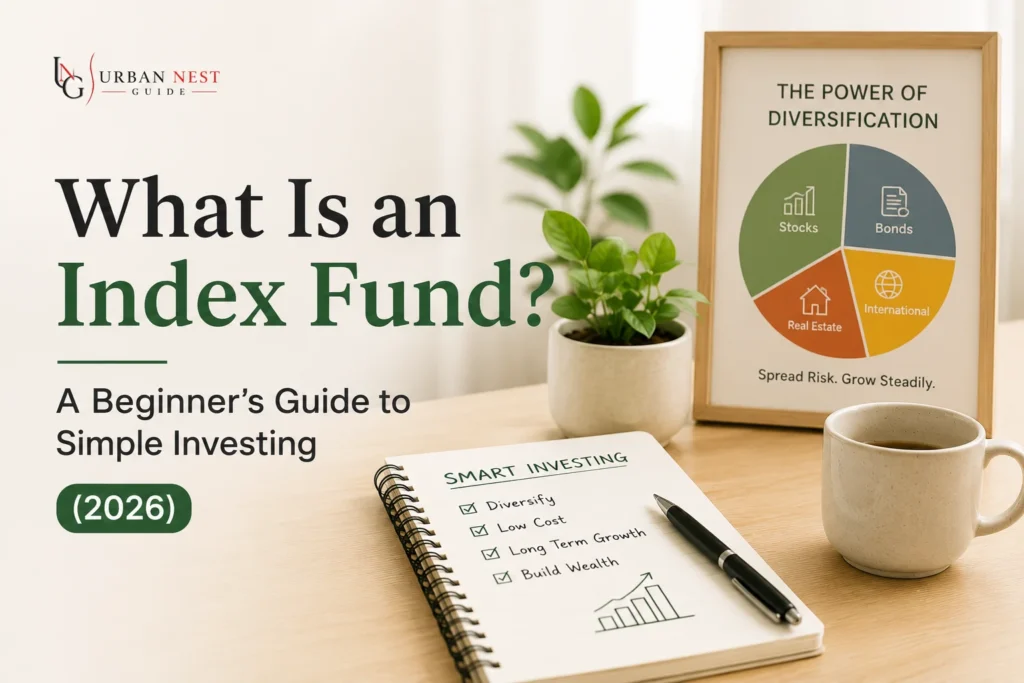
If you’ve ever thought “investing is too complicated for me,” this guide is going to change your mind.
Because there’s one investment that’s simple enough for a total beginner, cheap enough to start with pocket change, and so effective that Warren Buffett recommends it for his own family.
It’s called an index fund, and it might be the most beginner-friendly way to build wealth ever invented.
In this guide, you’ll learn exactly what an index fund is, how it works, why the world’s best investors swear by it, and how to buy your first one in 2026.
Let’s get into it.
What Is an Index Fund? (Simple Definition)
An index fund is a type of investment that automatically buys a little piece of every company in a market index.
A market “index” is just a scoreboard that tracks a group of stocks. The most famous is the S&P 500, which tracks 500 of the largest companies in the United States; think Apple, Microsoft, Amazon, and Coca-Cola.
When you buy an S&P 500 index fund, you’re not betting on one company. You’re buying a tiny slice of all 500 at once.
Here’s a simple way to picture it:
Instead of trying to pick the one winning apple at the market, you buy the whole orchard. Some trees do great, some don’t, but overall, the orchard grows over time.
That’s the magic. You own the whole market, so you win when the market wins.
How Do Index Funds Actually Work?
Index funds are what’s called a “passive” investment. Nobody is actively trying to pick hot stocks.
Instead, the fund simply copies its index. If the S&P 500 adds a company, the fund adds it. If a company drops off the list, the fund drops it too.
Here’s the step-by-step of what happens when you invest:
- You put money into the fund (say, $100).
- The fund pools your money with millions of other investors.
- That pool automatically buys shares of every company in the index, in the right proportions.
- As those companies grow and pay dividends, your slice grows too.
Because a computer just mirrors the index instead of paying expensive analysts to guess, the costs stay incredibly low. And as you’ll see, low costs are a huge deal.
Index Fund vs ETF vs Mutual Fund: What’s the Difference?
Beginners get tripped up here, so let’s clear it up fast.
An index fund is a strategy (tracking an index). It can come in two wrappers: a mutual fund or an ETF.
|
Feature |
Index Mutual Fund |
Index ETF |
| How it trades | Once per day, after market close | All day, like a stock |
| Minimum to start | Sometimes $0–$3,000 | Price of 1 share (or $1 with fractional) |
| Best for | Automatic recurring investing | Flexibility and low entry cost |
| Example | FXAIX, SWPPX | VOO, VTI |
The takeaway: Both are excellent. ETFs are usually easier for beginners because you can start with a single share (or even a fraction of one). Mutual funds are great for “set it and forget it” automatic monthly investing.
Don’t overthink it. A low-cost S&P 500 index fund is a solid choice in either form.
Why Beginners (and Experts) Love Index Funds
Here’s where index funds go from “interesting” to “wow”.
1. Even the pros can’t beat them
You’d think highly paid Wall Street fund managers with research teams and Bloomberg terminals would crush a simple index fund.
They don’t.
According to the SPIVA Scorecard from S&P Dow Jones Indices, roughly 84% of active U.S. large-cap fund managers underperformed the S&P 500 over a 10-year period. Stretch it to 15–20 years, and around 90% fail to beat it.
Let that sink in: nine out of ten professionals lose to a fund that simply owns everything.
2. Warren Buffett recommends them
Warren Buffett, arguably the greatest investor alive, has been blunt about this. In his instructions for the money he’ll leave his wife, he directed the trustee to put 90% in a low-cost S&P 500 index fund and 10% in short-term government bonds.
In his words:
“I believe the trust’s long-term results from this policy will be superior to those attained by most investors, whether pension funds, institutions, or individuals who employ high-fee managers.”
When the best stock picker on earth tells regular people to just buy the index, it’s worth listening.
1. The fees are tiny (and fees matter enormously)
This is the quiet superpower of index funds.
An actively managed fund might charge 0.50%–1.50% per year. A top index fund like Vanguard’s VOO charges just 0.03%.
That gap sounds small. It isn’t.
On a $100,000 portfolio, a 1% fee costs you $1,000 every year and that money can’t compound for you anymore. Over decades, high fees can quietly eat six figures of your wealth.
2. Instant diversification
Buy one S&P 500 index fund and you instantly own 500 companies across every major industry.
If one company stumbles, the other 499 cushion the blow. You’re never betting your future on a single stock.
The Different Types of Index Funds
“Index fund” isn’t one single thing. There are several kinds, and knowing the main categories helps you choose.
Stock market index funds. These track a stock index like the S&P 500 (500 large U.S. companies) or a total-market index (nearly every U.S. public company). This is where most beginners start.
International index funds. These track companies outside the U.S., giving you global exposure so you’re not 100% dependent on the American economy.
Bond index funds. These track bonds instead of stocks. They’re less volatile and often used to add stability, especially as you get closer to needing the money.
Sector or specialty index funds. These track a specific slice, like technology or real estate. More focused means more risk, usually not where beginners should begin.
A popular beginner strategy is the “three-fund portfolio”: a U.S. stock index fund, an international stock index fund, and a bond index fund. Simple, diversified, and low-cost. But even a single broad S&P 500 or total-market fund is a perfectly reasonable starting point.
What Is an Expense Ratio? (And Why It’s the Number That Matters)
If you remember one technical term from this guide, make it expense ratio.
The expense ratio is the annual fee a fund charges, expressed as a percentage of your investment.
- A 0.03% expense ratio means you pay $3 per year for every $10,000 invested.
- A 00% expense ratio means you pay $100 per year for every $10,000 invested.
That difference looks tiny. Over a lifetime, it’s staggering.
Imagine two investors, both putting in $10,000 a year for 30 years at a 10% return. One pays 0.03%; the other pays 1%.
The low-fee investor ends up with roughly $150,000 more, purely because less of their money leaked out in fees each year. That’s a house deposit lost to a “small” percentage.
The rule is simple: for index funds, always look for the lowest expense ratio. Since index funds all just track the same index, there’s no reason to pay more. Aim for under 0.10%.
What Kind of Returns Can You Expect?
Historically, the S&P 500 has returned about 10% per year on average over the long run (closer to ~7% after inflation).
Important: that’s an average, not a guarantee. Some years it soars 25%. Some years it drops 20% or more. But over long periods 10, 20, 30 years the trend has been strongly upward.
This connects directly to compound interest. Using the Rule of 72 (divide 72 by your return to see how long money takes to double), a 10% return doubles your money roughly every 7 years.
So $10,000 left to grow could become ~$20,000 in about 7 years, ~$40,000 in 14, and ~$80,000 in 21 without you adding a dime. That’s the power you’re tapping into.
A Short History: Where Index Funds Came From
Index funds feel obvious today, but they were once considered a crazy idea.
Back in 1976, a man named John “Jack” Bogle launched the first index fund for everyday investors through his company, Vanguard. Wall Street mocked it. Critics called it “Bogle’s Folly” and argued that settling for “average” market returns was un-American.
Bogle’s insight was simple but radical: since most professional managers fail to beat the market after fees, why not just buy the market at rock-bottom cost and keep the difference?
Decades of data proved him right. Today, index funds hold trillions of dollars, and Bogle is celebrated as a hero of the everyday investor. Even Warren Buffett praised him, saying Bogle did more for individual investors than anyone he’d ever known.
The lesson for you: the “boring” strategy that Wall Street laughed at has quietly made more regular people wealthy than almost any flashy alternative.
How to Start Investing in Index Funds (Step by Step)
Ready to buy your first one? Here’s the beginner path.
- Pick where to invest. Open an account with a major brokerage like Fidelity, Charles Schwab, or Vanguard. All three are reputable and beginner-friendly.
- Choose the right account type. For long-term goals, a Roth IRA is fantastic; your money grows tax-free. In 2026, you can contribute up to $7,500 ($8,600 if you’re 50+). No employer plan? A regular taxable brokerage account works too. If your job offers a 401(k) with a match, start there first; that’s free money.
- Fund your account. Link your bank and transfer money in. You can start with as little as $1 using fractional shares.
- Pick a low-cost index fund. Popular beginner options include broad S&P 500 funds (like VOO or FXAIX) or total-market funds (like VTI) that hold the entire U.S. stock market. Look for a low expense ratio (under 0.10%).
- Buy, then automate. Purchase your shares, then set up automatic monthly investing. This is called dollar-cost averaging, and it removes the stress of trying to time the market.
- Leave it alone. Seriously. Check it once or twice a year. Investors who tinker constantly tend to earn worse returns than those who stay the course.
How Much Should You Invest in Index Funds?
Once you’re ready, a natural question is, how much of my money should go in? There’s no single answer, but here are beginner-friendly guidelines.
Invest only what you won’t need for 5+ years. The stock market is for long-term goals. Money you’ll need soon (rent, a car next year) belongs in savings, not in index funds.
A common target is 15% of your income toward retirement and long-term investing. If that feels like too much right now, start with whatever you can, even 1% and increase it over time.
Use the “pay yourself first” method. Automate your investment the day you get paid, before you have a chance to spend it. Treat it like a non-negotiable bill.
Increase it with every raise. When your income goes up, bump your automatic contribution before lifestyle creep absorbs the extra. This is one of the most painless ways to build serious wealth.
Remember, the amount matters less than the consistency. A steady $100/month invested for 30 years beats a one-time $5,000 that you never add to.
Index Funds and Age: A Simple Rule of Thumb
Your mix of investments can shift as you age. Younger investors can take more risk because they have decades to recover from downturns; older investors typically want more stability.
One classic (if simplified) guideline is the “120 minus your age” rule for deciding how much to keep in stock index funds:
- At age 25: 120 – 25 = 95% in stock index funds, 5% in bonds.
- At age 40: 120 – 40 = 80% in stocks, 20% in bonds.
- At age 60: 120 – 60 = 60% in stocks, 40% in bonds.
The idea is to gradually dial down risk as you approach the time you’ll need the money. This isn’t a strict law; many young investors happily go 100% stocks, but it’s a helpful starting framework for thinking about risk and your timeline.
The Risks You Should Know
Index funds are simple, not magic. Be clear-eyed about the risks:
- They can lose: The market regularly drops 10–20% and has fallen more in major crashes. Only invest money you won’t need for 5+ years.
- You get market returns, no: By design, you’ll never beat the index. But as the data shows, that’s a feature, not a bug.
- They require the real growth to happen over decades. Panic-selling during a dip is the #1 way beginners lose money.
The single biggest risk isn’t the fund; it’s your own behavior during a downturn.
Common Index Fund Mistakes to Avoid
- Waiting for the “perfect time.” Time in the market beats timing the market. Start now.
- Panic-selling in a crash. Every past crash eventually recovered. Selling locks in the loss.
- Chasing last year’s hot fund. Yesterday’s winner is rarely tomorrow’s.
- Ignoring. A 1% fee doesn’t sound like much until you see the decades of compounding it steals.
- Investing emergency money. Your emergency fund belongs in a savings account, not the market.
Index Funds Myths That Hold Beginners Back
Let’s bust a few myths that stop people from getting started.
Myth 1: “I need a lot of money to invest.” False. With fractional shares, you can start with $1. Consistency beats a big lump sum every time.
Myth 2: “Index funds are only for boring, average returns.” “Average” market returns have historically turned modest monthly contributions into hundreds of thousands of dollars. And remember, that “average” beats ~90% of the professionals trying to do better.
Myth 3: “I should wait until the market is low to invest.” Nobody can reliably time the market, not even the pros. Studies consistently show that “time in the market” beats “timing the market.” The best day to start was years ago; the second best is today.
Myth 4: “It’s too risky.” All investing carries risk, but a broad index fund is one of the least risky ways to invest in stocks because your money is spread across hundreds of companies. The bigger risk for most beginners is not investing at all and losing ground to inflation.
Myth 5: “I can beat the market myself.” Maybe, but the odds are steep. If ~90% of full-time professionals with research teams can’t beat the S&P 500 over the long run, it’s wise to be humble about our own chances.
How Index Funds Fit Into Your Bigger Financial Picture
Index fund investing doesn’t happen in a vacuum. It’s one piece of a healthy financial plan. Here’s roughly where it fits for most beginners:
- Budget first. Use a system like the 50/30/20 rule to free up money to invest.
- Build an emergency fund. Don’t invest money you might need within five years.
- Kill high-interest. Paying off a 22% credit card beats almost any investment return; see debt vs. investing.
- Then invest consistently in low-cost index funds and let compound interest do the heavy lifting.
Index funds are the “grow your wealth” engine, but the foundation (budgeting, emergency fund, debt) has to be in place first.
A Real-World Example
Meet Jordan, a 25-year-old who could invest $200 a month.
He didn’t try to pick stocks. He opened a Roth IRA, bought a low-cost S&P 500 index fund, automated
$200 a month and ignored the noise.
Assuming a historical average return (~10%), here’s roughly how his consistency could pay off:
| Years invested | Total contributed |
Estimated value |
| 10 years | $24,000 | ~$38,000 |
| 20 years | $48,000 | ~$137,000 |
| 30 years | $72,000 | ~$395,000 |
Notice the pattern: he contributed $72,000 over 30 years but ended with roughly $395,000. The extra
~$323,000 came from compounding the market and time doing the heavy lifting.
That’s the beauty of index fund investing. You don’t have to be a genius. You just have to start early, keep it cheap, and stay consistent.
FAQs
Q1. What is an index fund in simple terms?
An index fund is an investment that buys a small piece of every company in a market index, like the S&P 500. Instead of picking individual stocks, you own the whole market at once, which spreads out your risk and keeps costs very low.
Q2. Are index funds good for beginners?
Yes. Index funds are widely considered one of the best investments for beginners because they’re simple, low-cost, automatically diversified, and historically outperform most actively managed funds. Even Warren Buffett recommends them for everyday investors.
Q3. How much money do I need to start investing in index funds?
You can start with as little as $1 thanks to fractional shares offered by brokerages like Fidelity, Schwab, and Vanguard. Many index funds have no minimum. What matters most is starting and investing consistently over time.
Q4. What’s the difference between an index fund and an ETF?
An index fund is a strategy that tracks an index, and it can be structured as a mutual fund or an ETF. ETFs trade all day like stocks and usually have lower entry costs, while index mutual funds trade once daily and are great for automatic recurring investing.
Q5. Can you lose money in an index fund?
Yes, index funds can lose value in the short term because they follow the market, which regularly dips. However, over long periods (10+ years), the S&P 500 has historically trended upward, returning about 10% per year on average.
Q6. Which index fund is best for beginners?
A broad, low-cost S&P 500 fund (such as VOO or FXAIX) or a total U.S. market fund (like VTI) is a great starting point. Look for a very low expense ratio, ideally under 0.10%. Always do your own research before investing.
Educational content and not financial advice. Figures are 2026 estimates; verify before relying on them.
About The Author