 Akash Kumar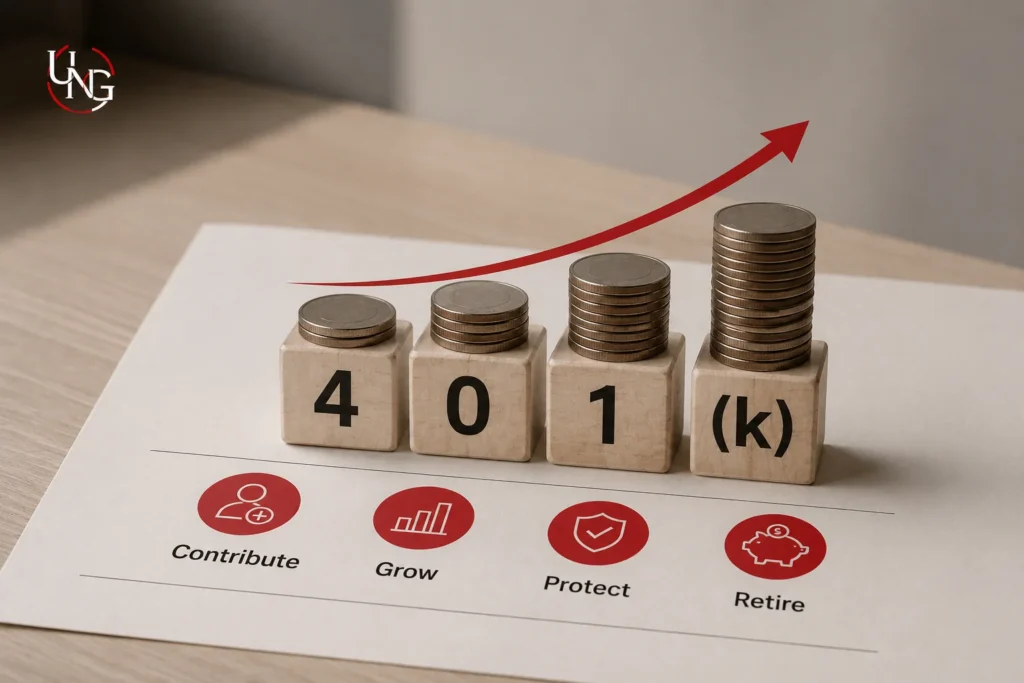
If your job offers a 401(k) and you’ve never really understood what it’s doing with your money, you’re in good company.
Most people sign the paperwork during new hire orientation, pick a percentage that sounds reasonable, and never think about it again.
That’s not a terrible strategy, honestly but a little bit of understanding turns a vague habit into a plan you can actually trust. Let’s walk through it properly.
Quick Answer
A 401(k) is a retirement account offered through your job that takes money straight out of your paycheck before you ever see it and invests it for your future, often with your employer adding free money on top through a match. For 2026, you can contribute up to $24,500 if you’re under 50, and there’s a real, important change this year: if you’re 50 or older and earned more than $150,000 last year, your catch-up contributions now have to go into a Roth account instead of a traditional one.
What a 401(k) Actually Is?
A 401(k) is a employer sponsored retirement plan offered through your job. Before your paycheck ever hits your bank account, a percentage you choose gets pulled out and put into investments, usually a mix of index funds and target date funds, inside the plan.
The name itself just refers to the section of the tax code that created it; there’s nothing more mysterious to it than that.
There are two main flavors. A traditional 401(k) takes your contribution before taxes are calculated, which lowers your taxable income right now, and you pay taxes later when you withdraw the money in retirement.
A Roth 401(k) does the opposite: you contribute money you’ve already paid tax on, and qualified withdrawals in retirement come out completely tax-free. If that sounds familiar, it’s the same basic tradeoff covered in our guide to Roth vs traditional IRAs, just inside a workplace plan instead of an account you open yourself.
2026 Contribution Limits, in Plain Numbers
The IRS raises these limits most years to keep up with inflation, and 2026 brought a genuinely meaningful increase. Here’s exactly what applies to you:
| Who you are | 2026 limit |
|---|---|
| Everyone, standard elective deferral | $24,500 |
| Age 50 or older, catch-up contribution | Additional $8,000 (total $32,500) |
| Age 60, 61, 62, or 63, “super catch-up” | Additional $11,250 (total $35,750) |
| Combined employee + employer contributions | $72,000 |
That combined $72,000 figure includes everything going into the account: your own contributions, your employer’s match, and any profit-sharing your company adds.
Very few people actually hit that ceiling; it mostly matters if you’re a high earner at a company with generous profit-sharing.
The Big Change for 2026: The New Roth Catch-Up Rule
This is the part of the 2026 rules that’s actually new, and it catches a lot of people off guard. Under a provision of the SECURE 2.0 Act, if you’re 50 or older and your wages from your employer were above $150,000 in 2025, any catch-up contribution you make in 2026 must go into a Roth account, not a traditional one.
You can still make your standard contribution as traditional if your plan allows it; it’s specifically the catch-up portion, the extra $8,000 or
$11,250, that has to be after-tax now.
Why it matters: catch-up contributions used to give high earners an immediate tax break, since traditional contributions lower your taxable income the year you make them.
Losing that option means your taxable income this year will be a bit higher than it would have been under the old rules, even though the money is still going toward retirement.
On the upside, it also means tax-free growth and tax-free withdrawals later, which isn’t a bad trade if you expect to be in a similarly high tax bracket in retirement anyway.
One wrinkle worth knowing: if your employer’s plan doesn’t offer a Roth option at all, you may lose the ability to make catch-up contributions altogether once this rule applies to you. If you’re in that situation, it’s worth asking your HR or plan administrator directly whether a Roth 401(k) option is being added.
Traditional 401(k) vs. Roth 401(k): The Full Comparison
Seeing both side by side usually makes the decision clearer than reading about them separately:
| Traditional 401(k) | Roth 401(k) | |
| Tax treatment now | Lowers taxable income this year | No upfront tax break |
| Tax treatment at withdrawal | Taxed as ordinary income | Tax-free, if rules are followed |
| Best guess required | Lower tax bracket in retirement | Same or higher bracket in retirement |
| Required minimum distributions | Yes, starting at a set age | No, as of current rules |
| 2026 catch-up for high earners (50+,
$150k+ wages) |
Not allowed for catch-up portion | Required for catch-up portion |
| Income limits to participate | None | None (unlike a Roth IRA, a Roth 401(k) has no income cap) |
That last row is worth pausing on: a regular Roth IRA cuts off eligibility at higher incomes, but a Roth 401(k) doesn’t. That makes the Roth 401(k) the only direct way many high earners can get money into a Roth account at all, aside from a more complex backdoor conversion.
What Your Money Is Actually Invested In
A 401(k) is a container, not an investment itself; the money inside it still has to be put into something. Most plans default new participants into a target date fund, a single fund named for the approximate year you plan to retire (something like “2060 Target Retirement Fund”), which automatically shifts from more stocks to more bonds as that year approaches. It’s a genuinely reasonable default for someone who doesn’t want to think about it.
Most plans also offer a menu of individual index funds you can choose instead, tracking things like the S&P 500 or the total U.S. stock market, similar to what’s covered in our guide to index funds and how they work. The one number worth checking on any fund in your plan is the expense ratio, the annual fee taken as a percentage of your balance. A fund charging 0.05% versus one charging 1.00% might sound like a small gap, but on a $200,000 balance held for 20 years, that difference alone can cost tens of thousands of dollars, even with identical underlying returns.
Auto-Enrollment and Auto-Escalation: Two Features Worth Understanding
Many employers now automatically enroll new hires into the 401(k) at a default percentage, often 3% to 6%, unless the employee actively opts out. If you were auto-enrolled and never touched the settings, it’s worth logging in and checking what percentage you’re actually contributing; the default is rarely the amount that gets you the full employer match, and it’s rarely 15%, either.
Some plans also offer auto-escalation, automatically increasing your contribution percentage by 1% each year, often timed with a typical raise cycle. If your plan offers this, turning it on is one of the easiest, most painless ways to reach a healthy contribution rate over a few years without ever having to make an active decision about it.
401(k) Loans and Hardship Withdrawals: The Emergency Exit
Most plans allow you to borrow against your own balance, typically up to 50% of your vested amount or $50,000, whichever is smaller, and pay it back to yourself with interest over roughly five years through payroll deduction. It avoids the taxes and penalty of an early withdrawal, but it comes with a real catch: if you leave your job with an outstanding loan balance, it often becomes due in full very quickly, and an unpaid balance gets treated as a taxable withdrawal.
Hardship withdrawals are a separate, narrower option for specific situations like preventing eviction, certain medical expenses, or a first-time home purchase. Unlike a loan, this money doesn’t get paid back, and it’s usually still subject to income tax and, unless an exception applies, the 10% early withdrawal penalty. Both options exist for real emergencies; neither is a substitute for the kind of accessible emergency fund covered in our emergency fund guide, which is specifically designed to absorb a surprise expense without touching retirement money at all.
Employer Match: The Closest Thing to Free Money You’ll Ever See
A lot of employers match part of what you contribute, commonly something like 50 cents on the dollar up to 6% of your salary, or a full dollar-for-dollar match up to 3%. The exact formula varies by company, but the principle is the same everywhere: if you contribute less than what your employer is willing to match, you are turning down part of your compensation for no reason at all.
Say you earn $60,000 a year and your employer matches 50% of your contributions up to 6% of your salary. Contributing 6% of your pay means $3,600 a year comes out of your paycheck, and your employer adds another
$1,800 on top, completely free. Contribute less than 6%, and you’re leaving part of that $1,800 on the table every single year you do it.
How Much Should You Actually Contribute?
A common, reasonable target is 15% of your income toward retirement total, employer match included. If that number feels out of reach right now, it usually is for people early in their career, and that’s fine. A more realistic starting sequence looks like this:
- Contribute at least enough to get your full employer match; this comes first, always.
- Once that’s automatic, work on building a real emergency fund using something like our emergency fund guide so a surprise expense doesn’t force you to raid your retirement account early.
- From there, increase your 401(k) percentage by 1% every time you get a raise, before you get used to the extra money in your paycheck.
- If you’re building a full budget around all of this, the 50/30/20 budgeting rule is a simple way to see where retirement savings actually fits alongside everything else.
What Happens to Your 401(k) When You Change Jobs
Your own contributions are always 100% yours, immediately. Employer contributions often follow a vesting schedule, meaning you need to stay a certain number of years before that money fully belongs to you. A common setup is graded vesting over three to five years; leave before you’re fully vested, and you forfeit some or all of the unvested employer money.
When you leave a job, you generally have four options: leave the money where it is if your former employer allows it, roll it into your new employer’s 401(k), roll it into an IRA, or cash it out. That last option almost never makes
sense before retirement age; you’ll owe income tax plus a 10% early withdrawal penalty on top, which can easily eat a third or more of the balance. A direct rollover into an IRA or a new 401(k) avoids both.
Mistakes That Quietly Cost People the Most
- Not contributing enough to get the full employer match, effectively turning down part of a raise.
- Cashing out a 401(k) after leaving a job instead of rolling it over, which triggers taxes and a penalty.
- Never increasing the contribution percentage, even after several raises.
- Ignoring fund fees inside the plan: a fund with a 1% expense ratio versus a 0.05% index fund can cost tens of thousands of dollars over a career, even with identical returns before fees.
- Treating the 401(k) as untouchable and never checking what it’s actually invested in; a default target date fund is fine, but it’s worth knowing that’s where the money is going.
The Real Power Here Is Time, Not Timing
Two people, same $500-a-month contribution, same 7% average annual return. One starts at 25, the other at 35. By 65, the person who started at 25 has contributed $60,000 more in total but ends up with roughly double the balance, because the extra ten years of compounding did more work than any amount of contribution increases could make up for later. This is the entire argument for starting now, even small, rather than waiting for the “right time” to start big.
A Second Example: What This Looks Like at a Real Salary
Numbers land differently depending on what you actually earn, so here’s a more grounded version. Maria earns
$45,000 a year at a company offering a 50% match up to 6% of pay. She contributes 6%, or $2,700 a year, and her employer adds $1,350. That’s $4,050 a year going into her account for a $2,700 out-of-pocket cost, before any investment growth at all.
Over 30 years at a 7% average annual return, that combined contribution alone (ignoring any raises along the way) grows to somewhere around $400,000, more than she’ll have personally contributed several times over.
Now compare that to David, who earns $90,000 with the same 50%-up-to-6% match, but only contributes 3% because “it’s already something.” He’s putting in $2,700 a year, identical to Maria in dollar terms, but he’s leaving roughly $900 a year in unclaimed match on the table, money his employer was ready to give him for free.
Over 30 years, that gap alone is worth well over $80,000 in lost growth. Income level matters less here than simply contributing enough to capture the full match.
Key Takeaways
- The 2026 401(k) limit is $24,500, plus $8,000 catch-up at 50+, or $11,250 for ages 60–63.
- New for 2026: high earners (over $150,000 in wages) must make catch-up contributions as Roth. Always contribute enough to get your full employer match first; it’s free money.
- Rolling over a 401(k) when you change jobs avoids taxes and penalties; cashing out rarely makes sense before retirement.
FAQs
Q1. Is a 401k worth it if my employer doesn’t match?
Yes, though the urgency is lower. Without a match, the main benefit is the tax-advantaged growth itself, pre-tax now or tax-free later depending on traditional versus Roth. It’s still generally worth using before a regular taxable brokerage account, but there’s less pressure to prioritize it over other goals.
Q2. Can I lose money in a 401k?
Yes, since the money is invested, usually in mutual funds or index funds that move with the market. Short-term dips are normal and expected; the account is designed to be held for decades, not judged month to month.
Q3. What happens if I contribute too much to my 401k in 2026?
Contributions above the $24,500 limit (or $32,500/$35,750 with catch-up) need to be corrected with your plan administrator, usually by withdrawing the excess before the tax filing deadline, to avoid double taxation.
Q4. Should I choose traditional or Roth 401k?
If you expect to be in a lower tax bracket in retirement than you are now, traditional generally wins. If you expect a similar or higher bracket later, or you simply want tax-free withdrawals with no surprises, Roth is usually the stronger choice. Many people split contributions between both.
Q5. Does the new Roth catch-up rule affect everyone over 50?
No, only those who earned more than $150,000 in wages from their employer in the prior year. Everyone else can still choose traditional or Roth for their catch-up contributions as before.
Q6. What is the difference between a 401k and a pension?
A pension is funded and managed entirely by your employer and pays a set benefit in retirement, regardless of market performance. A 401(k) is funded primarily by you, invested in the market, and its final value depends entirely on contributions and investment returns. Pensions have become rare in the private sector; most workers today rely on a 401(k) instead.
Q7. Can I have a 401k and an IRA at the same time?
Yes, and many people do. Contributing to both isn’t a conflict; the annual limits are separate, so maxing out a 401(k) doesn’t reduce how much you can put into an IRA in the same year.
Q8. What happens to unvested employer contributions if I get laid off?
Unvested amounts are generally forfeited back to the plan; only the vested percentage, based on your plan’s vesting schedule, is yours to keep or roll over.
Disclaimer: This article is for general education, not financial advice.
About The Author