
 Akash Kumar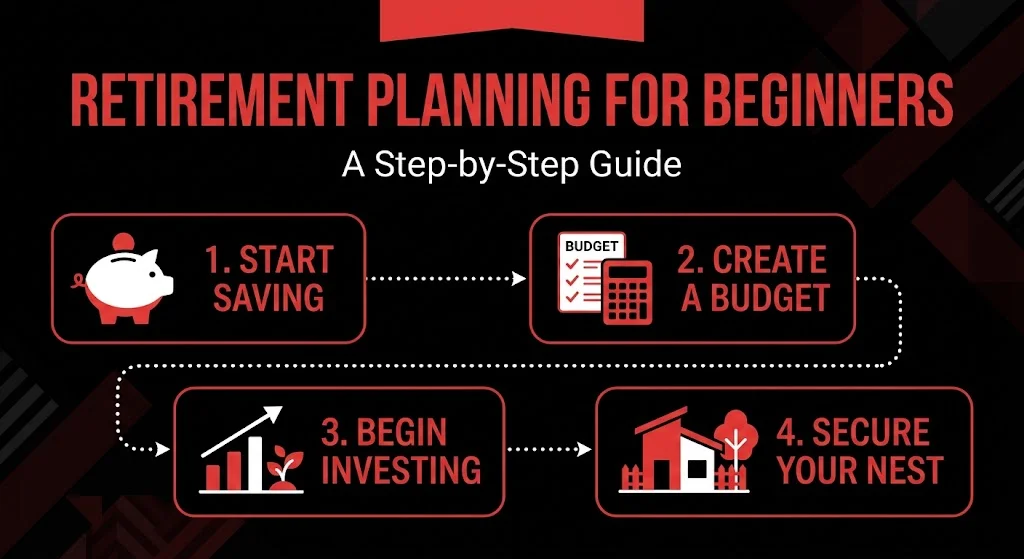
Retirement can feel impossibly far away, or impossibly expensive, or both. So most people avoid thinking about it entirely, which is exactly the wrong move.
Here is the truth that changes everything: thanks to compound growth, the money you invest in your 20s and 30s does the most work of all. You do not need to be rich or a finance expert to retire comfortably. You just need a plan and the willingness to start. This beginner-friendly guide breaks down how much you really need and how to get there.
Key Takeaways
How Much Money Do You Actually Need to Retire?
There is no single magic number, because it depends on the lifestyle you want. But two simple rules of thumb give you a solid starting point.
The first is Fidelity’s salary multiplier: aim to have about 10 times your annual salary saved by the time you retire around age 67. So if you earn $60,000, your target is roughly $600,000. The second is the 4% rule, which says you can safely withdraw about 4% of your savings in your first year of retirement, then adjust for inflation each year, and your money should last around 30 years. Flip that around and it means you need about 25 times your desired annual spending. Want $40,000 a year from your savings? You would aim for about $1 million.
Do not let these big numbers scare you. Remember that Social Security will cover part of your income, and that most of your nest egg will come from growth, not just the money you put in.
Retirement Savings Benchmarks by Age
Want to know if you are on track? These widely used benchmarks show roughly how many times your salary you should aim to have saved at each age.
| Age | Target saved | On a $60,000 salary |
| 30 | 1x your salary | about $60,000 |
| 40 | 3x your salary | about $180,000 |
| 50 | 6x your salary | about $360,000 |
| 60 | 8x your salary | about $480,000 |
| 67 | 10x your salary | about $600,000 |
If you look at those numbers and feel behind, you are in good company. The median American aged 45 to 54 has around $115,000 saved, well short of the benchmark. These targets are goalposts to aim for, not pass-or-fail tests. What matters is knowing where you stand and taking the next step.
Where to Put Your Retirement Savings
The account you use is almost as important as how much you save, because the right ones give you powerful tax breaks. Start with your workplace 401(k), especially if your employer offers a match; that match is free money and an instant return. Next, consider an IRA. Our guide on the Roth IRA versus traditional IRA explains the difference simply: a Roth gives you tax-free withdrawals later, while a traditional account lowers your taxes now.
Do not overlook a health savings account either, which offers a rare triple tax advantage and can double as a retirement tool. And inside any of these accounts, a simple low cost index fund is a beginner-friendly way to actually grow the money you contribute.
How Much Should You Save Each Month?
A widely recommended target is to put away about 15% of your gross income for retirement, including any employer match. On a $60,000 salary, that is roughly $750 a month. If that feels like too much right now, do not give up; start with whatever you can, even 3% to grab the match, and increase it by 1% every year or with every raise. Thanks to compounding, those small, steady contributions grow into surprisingly large sums over the decades.
Don’t Forget Social Security in Your Plan
Your savings will not have to do all the work; Social Security fills in a meaningful part of the picture for most Americans. The average benefit in 2026 is around $2,000 a month, and the amount you receive depends on your earnings history and the age you start claiming. You can claim as early as 62, but your monthly check grows for every year you wait, up to age 70. That is why delaying, if you can afford to, is one of the simplest ways to boost your retirement income for life.
The key point for planning is this: do not guess your benefit, and do not overestimate it. Create a free account at the Social Security Administration to see your personalized estimate, then treat your own savings as the part you fully control. Together, your nest egg and Social Security form your retirement paycheck.
What If You Are Behind on Retirement Savings?
Being behind is common, and it is very fixable. Focus on three powerful levers. First, once you turn 50, use catch-up contributions, which let you put extra money into your 401(k) and IRA each year. Second, eliminate high interest debt to free up more cash for saving. Third, consider working just two or three years longer, which dramatically improves the math by giving your money more time to grow and shortening the years you need to fund.
Here is some encouragement backed by math: someone at age 50 with $120,000 saved who maxes out their 401(k) for the next 17 years could still end up with well over half a million dollars by 67, thanks to catch-up contributions and compound growth. It is genuinely never too late to improve your position. The worst thing you can do is give up because you feel behind; the best thing you can do is increase your contributions starting with your very next paycheck.
For your personalized Social Security estimate, create a free account at SSA.gov; knowing that number helps you plan the rest. And for unbiased retirement basics, Investor.gov is a trustworthy, ad-free guide.
Common Retirement Planning Mistakes to Avoid
- Not starting early enough. Waiting even a few years can cost you hundreds of thousands in lost compound growth.
- Leaving the employer match on the table. If you do not contribute enough to get the full match, you are turning down free money.
- Cashing out when changing jobs. Withdrawing your 401(k) early triggers taxes, penalties, and lost growth. Roll it over instead.
- Overestimating Social Security. It replaces only part of your income. Check your real estimate and plan the rest yourself.
- Keeping retirement money in cash. Uninvested money barely grows. Put it in diversified funds so it can compound.
A Simple Retirement Plan You Can Start This Week
Retirement planning sounds complicated, but your first steps are refreshingly simple. You do not need to figure out the perfect number today; you just need to start the engine. Here is a beginner-friendly sequence anyone can follow.
- Sign up for your workplace 401(k) and contribute at least enough to get the full employer match.
- Open a Roth IRA if you want tax-free growth, and set up a small automatic monthly contribution.
- Inside those accounts, choose a low cost index fund or a target-date fund that matches your retirement year.
- Increase your contribution by 1% every year, or whenever you get a raise.
- Check your Social Security estimate once a year and review your progress against the benchmarks.
That is genuinely enough to put you ahead of most people. The details can be refined over time, but the habit of consistent, automatic contributions is what does the heavy lifting. Start this week, even with a small amount, and let time do the rest.
FAQs
How much money do I need to retire comfortably?
A common benchmark is about 10 times your annual salary saved by age 67, or roughly 25 times your desired annual spending under the 4% rule. On a $60,000 salary, that is around $600,000, supplemented by Social Security. Your exact number depends on your lifestyle.
How much should I have saved for retirement by age 40?
A widely used benchmark suggests having about 3 times your annual salary saved by age 40. On a $60,000 salary, that is roughly $180,000. If you are behind, increasing your contribution rate and staying invested can close the gap over time.
What is the 4% rule for retirement?
The 4% rule says you can withdraw about 4% of your retirement savings in your first year, then adjust for inflation each year, with a good chance your money lasts around 30 years. On $1 million in savings, that is about $40,000 in the first year.
When should I start saving for retirement?
As early as possible, ideally in your 20s, because compound growth rewards time more than anything else. Even small amounts invested early can outgrow much larger amounts invested later. If you have not started, the next best time is today.
Trusted resources: Investor.gov, Social Security Administration, and IRS.
Disclaimer: This article is for general education, not financial advice. Retirement needs vary; consider consulting a licensed financial professional for a personalized plan.
About The Author








1 thought on “Retirement Planning for Beginners: How Much You Need (2026)”