 Akash Kumar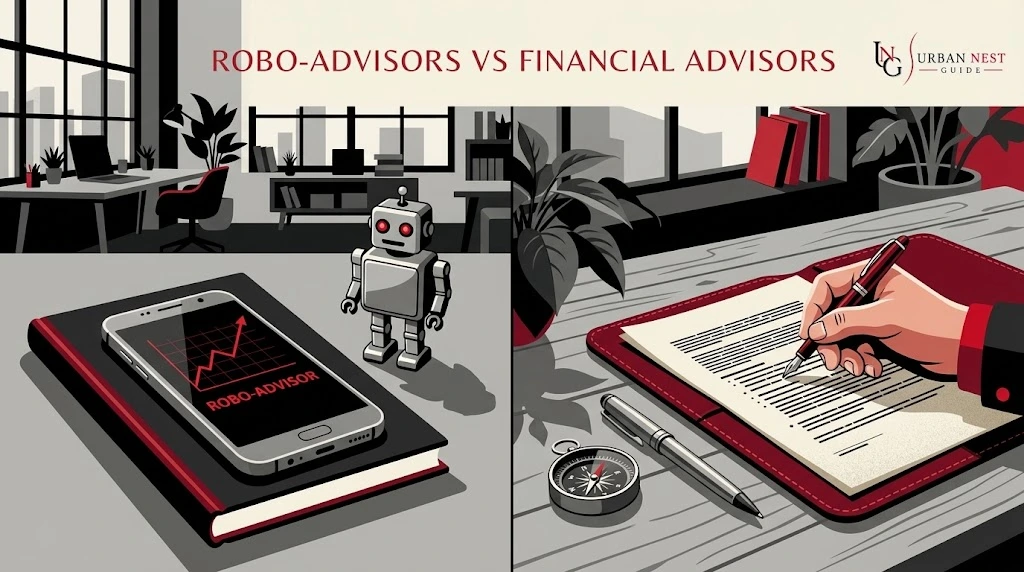
A human financial advisor typically charges about 1% of your portfolio every year.
A robo-advisor typically charges about 0.25%.
On a $100,000 portfolio, that’s $1,000 a year versus $250. Same basic job: build you a diversified portfolio and manage it.
So why does anyone still pay for a human? Here’s exactly what you get, and give up, with each option.
Quick Answer
A robo-advisor is an automated investing platform that builds and manages a diversified portfolio for you, based on your goals and risk tolerance, for a low flat fee, typically around 0.25% a year.
A human financial advisor does similar portfolio work, typically for about 1% a year, but adds personalized planning, tax strategy, and someone to talk to during a crisis.
For most people with straightforward goals, a robo-advisor covers the basics well. Complex situations still benefit from a human.
Let’s break down exactly where the line is.
How a Robo-Advisor Actually Works
You answer a questionnaire: age, income, goals, and how you’d react to a market drop.
An algorithm uses that to build a diversified portfolio, almost always using low-cost index funds and ETFs, matched to your risk tolerance and timeline.
From there, it runs mostly on autopilot:
- Automatic rebalancing. If stocks grow faster than bonds and your allocation drifts, the platform sells a bit of one and buys the other to get back on target.
- Tax-loss harvesting. Many platforms automatically sell losing positions to offset gains elsewhere, reducing your tax bill, and then buy a similar (not identical) investment to stay invested.
- Automatic deposits. Set a recurring contribution and the platform invests it automatically, keeping the portfolio on track without manual trades.
It’s essentially the same diversified, low-cost strategy a good human advisor would build, minus the meetings.
What a Human Advisor Actually Adds
The portfolio management part, honestly, isn’t where humans separate themselves anymore. It’s everything around it:
- Complex tax situations: Multiple income sources, business ownership, stock options, or a messy year needing real planning.
- Estate planning coordination: Working alongside an attorney on trusts, wills, and beneficiary strategy.
- Behavioral coaching during a crisis: Talking someone out of panic-selling during a crash is a real, valuable service an algorithm doesn’t provide.
- Holistic financial planning: Coordinating investments with insurance, debt payoff, and major life decisions like a business sale or inheritance.
If your situation is genuinely simple, saving for retirement, no complex tax situation, a robo-advisor covers the core job well. Complexity is where the extra fee starts earning its keep.
The Real Fee Math Over Time
| Robo-Advisor (~0.25%) | Human Advisor (~1.00%) | |
| Annual fee on $100,000 | $250 | $1,000 |
| Annual fee on $500,000 | $1,250 | $5,000 |
| Fee over 20 years on $100,000 (no growth) | $5,000 | $20,000 |
| What you get beyond investing | App support, occasional human chat | Dedicated planning, tax strategy, coaching |
The fee gap compounds. A 0.75-point difference doesn’t just cost you the fee itself, it costs you the growth that money would have earned had it stayed invested instead.
| Real Example: The 20-Year Fee Gap
Elena invests $200,000 with a robo-advisor at a 0.25% annual fee. Diego invests the same $200,000 with a human advisor at 1.00%. Assume both portfolios grow at an identical 7% gross return before fees over 20 years. Elena’s account, after her lower fee, grows to roughly $720,000. Diego’s account, after his higher fee, grows to roughly $610,000, even with identical investment performance. That gap, over $100,000, is the actual cost of the 0.75-point fee difference compounding over two decades, not just the annual dollar amount. |
Who Should Actually Pick Which
Pick a robo-advisor if:
- Your main goal is straightforward: retirement savings, a house down payment, and general long-term growth.
- You don’t have a complex tax situation, business ownership, or major upcoming life event needing coordination.
- You’re comfortable being mostly hands-off and trust a systematic, algorithm-driven approach.
Pick a human advisor if:
- You’re navigating something complex: a business sale, inheritance, divorce, or stock compensation.
- You specifically want a person accountable to you, especially during volatile markets.
- Your tax situation benefits from active, personalized strategy beyond automated tax-loss harvesting.
The Middle Ground: Hybrid Advisory Services
Several platforms now offer a hybrid model: robo-advisor-level automated management, plus access to a human advisor for periodic check-ins, usually for a fee between the two extremes, often around 0.30% to 0.50%.
This can be the practical answer for people who want algorithmic efficiency most of the time but a real person to call before a major decision.
6 Mistakes People Make With Robo-Advisors
Mistake #1: Assuming all robo-advisors charge the same fee
Fees range from free (with account minimums or bundled banking products) to around 0.50%. Compare actual fee schedules before choosing one.
Mistake #2: Ignoring the underlying fund expense ratios
The robo-advisor’s management fee is separate from the expense ratios of the funds it invests you in. Both matter to your total cost.
Mistake #3: Using a robo-advisor for a genuinely complex situation
An algorithm isn’t built to navigate a business sale or a complicated inheritance. That’s exactly when the human fee starts paying for itself.
Mistake #4: Panic-withdrawing during a downturn anyway
A robo-advisor removes emotion from portfolio management, but not from your own decision to log in and hit withdraw during a scary week. That discipline is still on you.
Mistake #5: Not checking if tax-loss harvesting is actually included
Not every robo-advisor offers this, and it’s one of the bigger value-adds when it is. Confirm before assuming it’s part of the service.
Mistake #6: Switching platforms frequently
Moving investments between platforms can trigger taxable events and reset any long-term tax-loss harvesting benefit. Pick one and stay unless there’s a strong reason to move.
FAQs
Are robo-advisors actually safe?
Reputable robo-advisors are registered investment advisors, and your cash and securities are typically protected by SIPC insurance up to standard limits, similar to a traditional brokerage.
Can I lose money with a robo-advisor?
Yes. Your money is invested in the market, so it can go up or down in value. A robo-advisor doesn’t eliminate market risk, it just automates portfolio management.
Do robo-advisors work for retirement accounts?
Yes, most offer IRAs and Roth IRAs alongside taxable accounts, using the same automated approach.
Is it worth paying more for a human advisor?
It depends entirely on complexity. For straightforward, long-term investing, the extra fee is hard to justify. For complex tax or estate situations, it often is.
Can I switch from a robo-advisor to a human advisor later?
Yes, this is common as situations get more complex, like starting a business or receiving an inheritance. There’s no lock-in preventing the switch.
Do robo-advisors offer financial planning beyond investing?
Some do, to a limited degree, offering basic retirement or goal-planning tools. Comprehensive financial planning, though, is still typically a human advisor’s domain.
The old argument for human advisors, “you need an expert to pick good investments,” mostly doesn’t hold up anymore. Low-cost index investing made that part largely commoditized.
What’s left is genuinely valuable, but it’s not for everyone. Match the fee to the actual complexity of your situation, not to habit or assumption.
The Bottom Line
Robo-advisors typically charge around 0.25% a year versus about 1.00% for a human advisor for similar core portfolio management.
Over decades, that fee gap can compound into a genuinely large difference in your final portfolio value.
Robo-advisors handle straightforward goals well. Complex tax, estate, or business situations still benefit from a human advisor.
Hybrid services offer a middle ground for investors who want the low-cost automation of a robo-advisor with access to human guidance when it matters.
Sources Cited: Investor.gov, robo-advisers and automated investment tools. SEC, guidance on robo-adviser regulation
Disclaimer: This article is for general education, not financial advice.
About The Author