 Akash Kumar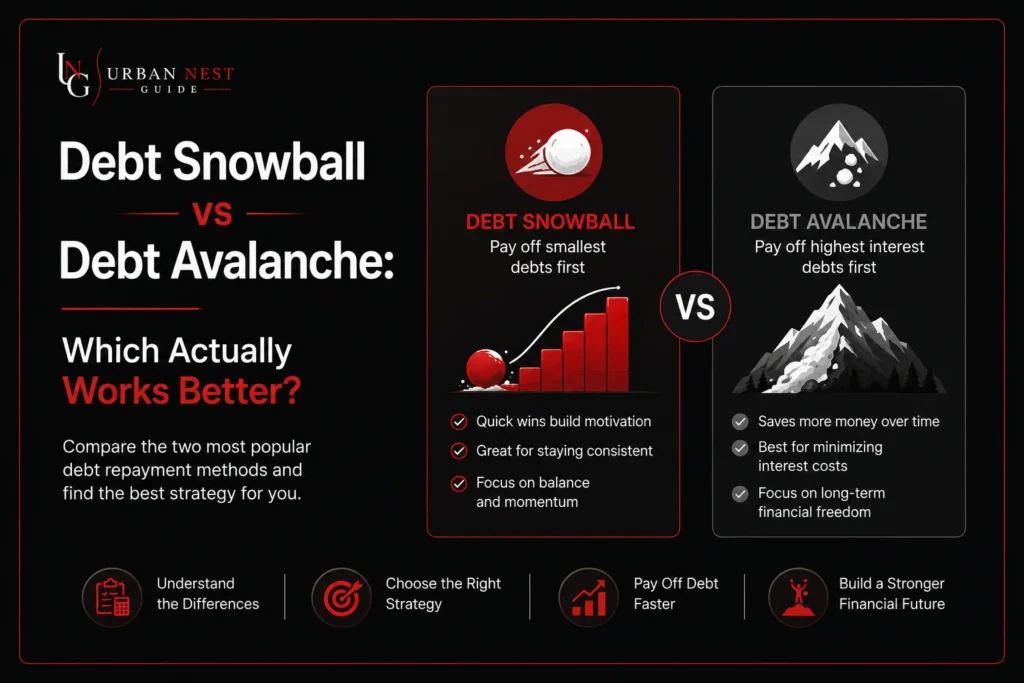
If you’ve got more than one debt and you’re not sure which to attack first, you’re already ahead of where most people start having a method beats having no plan at all.
Quick Answer
The debt snowball pays off your smallest balance first, regardless of interest rate, to build quick motivation. The debt avalanche pays off your highest interest rate first, which mathematically saves you the most money overall. Snowball wins on motivation; avalanche wins on math. The best method is whichever one you’ll actually stick with.
The Debt Snowball Method, Explained
List every debt from smallest balance to largest, ignoring interest rates entirely. Keep making minimum payments on everything, but throw every extra dollar you can at the smallest balance. Once it’s gone, roll that entire payment the old minimum plus whatever extra you were adding into the next-smallest debt. Each payoff builds momentum (hence “snowball”), which is exactly the point: this method is built around psychology, not math.
The Debt Avalanche Method, Explained
Same rolling process, different order: list debts from highest interest rate to lowest, and attack the highest-rate debt first regardless of its balance. Since high-interest debt costs you the most in the long run, this method minimizes total interest paid over the life of your payoff plan. It’s the mathematically optimal choice but progress on your largest, highest-rate debt can feel slower at first if that balance also happens to be large.
A Real Numbers Example
Say you have three debts: a $1,200 credit card at 24% APR, a $4,500 card at 19% APR, and a $2,800 personal loan at 9% APR, and you can put $300/month total toward extra payments beyond the minimums.
| Method | Payoff order | What it optimizes for |
| Snowball | $1,200 card ® $2,800 loan ® $4,500 card | Fastest first, win the smallest balance is gone soonest, which builds momentum early |
| Avalanche | $1,200 card ® $4,500 card ® $2,800 loan | Least total interest paid the 24% and 19% balances get attacked before the 9% loan |
In this example, both methods happen to start with the same $1,200 card (it’s both the smallest balance and effectively tied for the highest rate), but they diverge on what comes second. Avalanche will save more in interest paid over the full payoff period; snowball will usually feel faster early on because of how quickly that first small balance disappears.
So Which One Should You Actually Pick?
- Pick snowball if you’ve tried paying off debt before and lost motivation partway through; the quick wins genuinely help people stick with it.
- Pick avalanche if you’re disciplined about sticking to a plan regardless of visible progress and want to minimize what you pay in interest overall.
- Consider a hybrid: some people knock out one or two very small balances first for quick motivation, then switch to avalanche order for the rest.
Read Also: How to Build an Emergency Fund →
Don’t Skip These While You’re Paying Off Debt
- Keep making every minimum payment on time missed payments hurt your credit score regardless of which method you’re using.
- Keep a small starter emergency fund (even $500–$1,000) so one surprise expense doesn’t put you right back on a credit card.
- Avoid opening new debt while aggressively paying down existing balances; it undercuts the entire
FAQs
Q1. Does debt snowball hurt your credit score?
Not directly, paying down balances (in either order) generally helps your credit utilization ratio, which can improve your score over time, as long as you keep making minimum payments on everything else on schedule.
Q2. How long does the debt avalanche method take?
It depends entirely on your total debt, interest rates, and how much extra you can pay each month. There’s no fixed timeline, but it will always finish with less total interest paid than snowball, given the same extra payment amount.
Q3. Can I switch from snowball to avalanche partway through?
Yes, there’s no penalty for switching methods. Some people start with snowball for early motivation, then switch to avalanche once they’ve built the habit of paying extra each month.
Q4. Is debt consolidation better than snowball or avalanche?
Consolidation can lower your interest rate or simplify multiple payments into one, but it’s a different tool, it doesn’t replace the need for a payoff strategy. Many people combine consolidation with either the snowball or avalanche order for whatever debt remains.
Key Takeaways
- Snowball = smallest balance first, built for motivation and momentum.
- Avalanche = highest interest rate first, built to save the most money.
- Keep minimum payments current on everything, no matter which method you choose.
- The best method is the one you’ll actually stick with until the last balance is gone.
Additional Resources: For more guidance on managing debt and understanding your consumer rights, visit the Consumer Financial Protection Bureau’s Debt Collection Resources and the Federal Trade Commission’s Coping with Debt guide.
Educational content and not financial advice. Figures are 2026 estimates; verify before relying on them.
About The Author