
 Akash Kumar
Let us be honest about something. For a lot of people, the word “budget” lands somewhere between “diet” and “dentist appointment,” useful, probably, but not exactly exciting. And if you have never made one before, the whole thing can feel genuinely overwhelming.
Where do you even begin? How much detail do you need? What if you mess it up? If those questions have kept you from starting, take a deep breath, because this guide is written for exactly that feeling.
This is one of the most common questions on Reddit’s personal finance communities: how do I start budgeting when I have no idea where to begin? The good news is that budgeting is far simpler than the internet makes it look. You do not need fancy software, a finance degree, or hours of free time. You need a starting point and a little patience, and by the end of this guide you will have both.
We are going to build your first budget together, one small step at a time, in plain language. No shame, no complicated spreadsheets, no pressure to be perfect. Just a simple system you can actually stick with. Let us begin.
Key Takeaways
Why Bother Budgeting at All?
Before we dive into the how, let us quickly answer the why, because motivation makes the habit stick. A budget is not about restriction or never having fun. It is about awareness and control. Most people who feel stressed about money are not necessarily broke; they simply have no clear picture of where their money is going. That fog is what causes the anxiety.
A budget clears the fog. It shows you exactly what comes in and what goes out, which puts you back in the driver’s seat. Suddenly you can see that the $60 here and $40 there on things you barely remember buying adds up to real money, money that could go toward a trip, an emergency fund, or simply not feeling stressed at the end of the month. Budgeting is how you make your money follow your priorities instead of the other way around.
Think of a budget as the foundation of your whole financial life. Everything else, saving, paying off debt, investing, gets easier once you know your numbers. If you want the big-picture view of how it all fits together, our guide on personal finance for beginners is a great companion to this one.
Step 1: Don’t Plan Yet, Just Track
Here is the mistake almost everyone makes: they try to build a perfect budget on day one, guessing what they should spend, and then feel like a failure when real life does not match the plan. We are going to skip that trap entirely. Your first step is not to plan; it is simply to watch.
For the next two to four weeks, just track everything you spend. Every coffee, every bill, every online order, every tank of gas. Do not judge it, do not try to change it, just record it. This is the single most valuable thing you can do as a beginner, because you cannot make a realistic plan for your money until you know where it actually goes right now.
On Reddit, experienced budgeters give this exact advice again and again, and they offer a shortcut too: pull up your last three to six months of bank and credit card statements. Your spending history is already recorded there. Go through it and you will get an instant, honest picture of your habits. As one popular comment put it, this is basically doing a budget after the fact, and it shows you the truth without any guessing. For help reading statements and spotting patterns, the Consumer Financial Protection Bureau offers free, plain-language guides.
Step 2: Find Your Real Numbers
Once you have tracked for a few weeks (or reviewed your statements), it is time to find the two numbers every budget is built on: your income and your expenses.
Start with your income, specifically your take-home pay. This is the amount that actually lands in your account after taxes and deductions, not the bigger salary number on your job offer. Budgeting off your take-home pay is essential because that is the real money you have to work with. If your income changes month to month, use a conservative average or your lowest recent month to stay safe.
Next, add up your expenses from your tracking. To keep it simple, sort them into two groups: needs and wants. Needs are things you truly cannot skip, like rent, utilities, groceries, transportation, insurance, and minimum debt payments. Wants are everything else: dining out, streaming, hobbies, and shopping. Do not stress about getting every item in the perfect category; the goal is a clear overall picture, not accounting perfection.
Then do one simple piece of math: subtract your total expenses from your take-home pay. This tells you where you stand right now.
| What you find | What it means | What to do |
| A positive number | You have money left over | Great, now give it a job (savings, debt, goals) |
| Around zero | You spend everything you earn | Look for expenses to trim so you can save something |
| A negative number | You spend more than you earn | This is urgent; cut expenses or raise income soon |
If that number is negative, do not panic and do not feel ashamed. Finding this out is exactly why you are budgeting, and now you can fix it. Knowledge is the first step; you cannot solve a problem you cannot see.
Step 3: Choose a Simple Budgeting Method
Now that you know your numbers, you need a simple framework to organize them. There are a few popular beginner methods, and the best one is simply the one you will actually use. Let us look at the three most common, from easiest to most detailed.
| Method | How it works | Best for |
| 50/30/20 rule | 50% needs, 30% wants, 20% savings/debt | Beginners who want simple and flexible |
| Zero-based budget | Give every single dollar a job until you reach zero | People who want full control and detail |
| Envelope method | Set cash (or digital) limits per category | People who tend to overspend in certain areas |
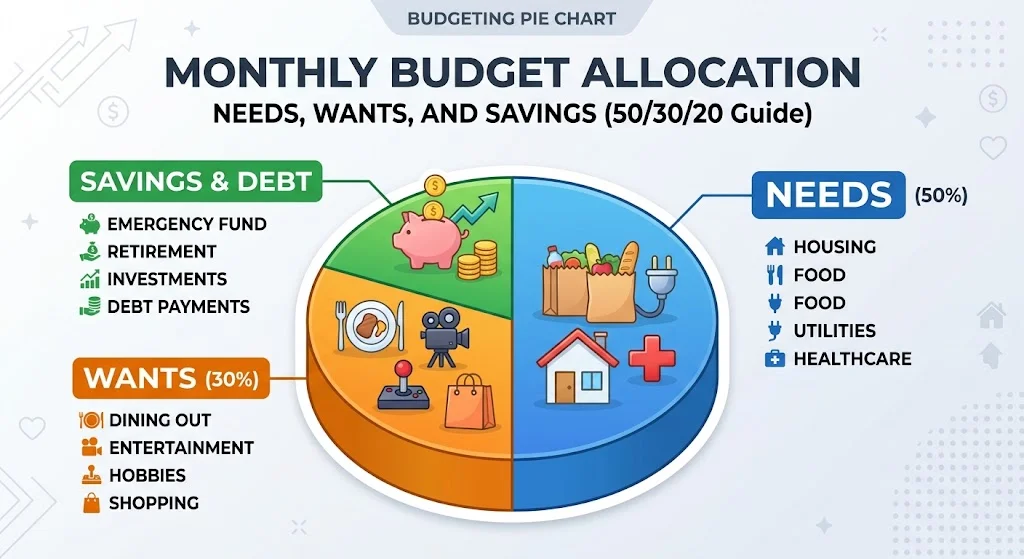
For most beginners, the 50/30/20 rule is the perfect starting point because it is forgiving and easy to remember. You aim to spend about 50% of your take-home pay on needs, 30% on wants, and put 20% toward savings and debt. It gives you guardrails without micromanaging every dollar. You can always graduate to a more detailed method later once budgeting feels natural.
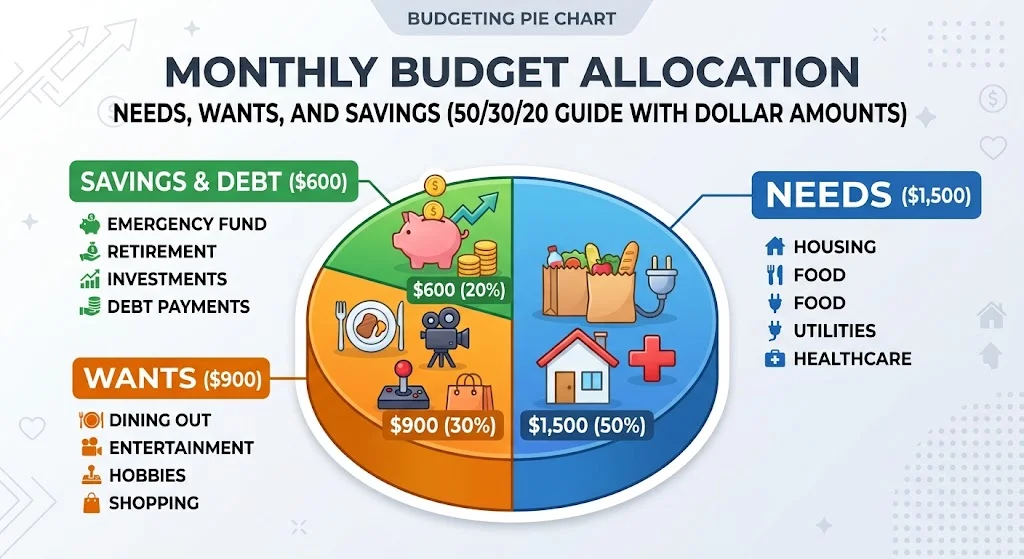
A quick, real example makes it click. Say your take-home pay is $3,000 a month. Under the 50/30/20 rule, that becomes roughly $1,500 for needs, $900 for wants, and $600 for savings and debt. Suddenly the abstract idea of a budget turns into concrete targets you can aim for.
Step 4: Give Every Dollar a Job
Here is the mindset shift that makes budgeting actually work: a budget is a plan you make before the month starts, not just a record of what happened after. This is sometimes called giving every dollar a job. Before the month begins, you decide where your money will go, assigning it to needs, wants, savings, and goals until it is all accounted for.
Why does this matter so much? Because money without a plan tends to disappear. When you tell each dollar where to go in advance, funneling some to rent, some to groceries, some to your emergency fund, some to fun, you spend with intention instead of drifting through the month and wondering where it all went. You are the one making the decisions, on purpose, ahead of time.
One of those jobs should always be paying yourself first. Before you budget for wants, set aside your savings, ideally with an automatic transfer to a high yield savings account the moment you get paid. That way your savings goal is protected instead of being whatever happens to be left over, which is usually nothing.
Step 5: Pick Your Tool (Keep It Simple)
New budgeters often get stuck here, spending days hunting for the perfect app and never actually starting. Do not fall into that trap. The best budgeting tool is the one you will genuinely use, and for most beginners that is something refreshingly simple.
- Pen and paper. A cheap notebook works perfectly. There is something powerful about physically writing down your numbers, and there is zero learning curve.
- A free spreadsheet. Google Sheets or Excel gives you a simple, flexible budget you fully control. Free templates are everywhere if you do not want to build one from scratch.
- A budgeting app. Apps can automate tracking by connecting to your accounts, which some people love. Just be sure the convenience is worth it, and watch for fees.
Notice that the humble notebook and free spreadsheet come first. That is intentional. Reddit’s budgeting veterans consistently say the same thing: do not let the search for the perfect app become an excuse to delay. Start today with whatever you have, even a scrap of paper, and upgrade your system later if you want to.
A Closer Look at the Three Budgeting Methods
We introduced the three main methods above, but let us go a little deeper so you can confidently pick the one that fits your personality. There is no single best method; there is only the best one for you.
The 50/30/20 rule is the gentle giant of budgeting. Its beauty is flexibility. You are not tracking forty tiny categories; you are just keeping three big buckets roughly in balance. This makes it very hard to quit, which is exactly why it is the top recommendation for beginners. The downside is that it is less precise, so if you tend to overspend, the loose structure might let a little too much slip through.
The zero-based budget is for people who love control. The idea is that your income minus your expenses should equal exactly zero, because every single dollar has been assigned a job, including dollars sent to savings and investing. Nothing is left floating and unaccounted for. It takes more effort each month, but people who use it often say it is the first time they truly felt in command of their money. It is fantastic once you are ready for a bit more detail.
The envelope method is the secret weapon for overspenders. Traditionally, you put cash into labeled envelopes, groceries, gas, fun, and when an envelope is empty, you stop spending in that category. Today many people do this digitally with separate accounts or budgeting apps. The physical limit creates a powerful psychological brake that abstract numbers on a screen sometimes cannot. If you have a category or two that always blows up your budget, try enveloping just those.
A smart move is to start with the 50/30/20 rule to build the habit, then borrow ideas from the others as you go. For example, you might run a simple 50/30/20 budget overall but use the envelope trick for dining out, your personal weak spot. Budgeting is not one-size-fits-all; the best system is the one you will actually stick with. Our detailed walkthrough of the 50/30/20 rule shows exactly how to set it up.
How to Actually Stick to Your Budget
Making a budget is the easy part; sticking to it is where most people struggle. The good news is that staying on track is less about willpower and more about setting up your life so the right choices happen naturally. Here are the habits that make budgeting stick.
- Automate everything you can. Set up automatic transfers for savings and automatic payments for bills. The less you have to decide each month, the more consistent you will be.
- Check in weekly, not just monthly. A quick five-minute look at your spending each week catches problems early, before they snowball into a blown budget.
- Build in fun money. A budget with zero room for enjoyment is a budget you will abandon. Always leave a guilt-free spending category, even a small one.
- Use visual reminders. A savings goal tracker on your fridge or phone keeps your ‘why’ front and center, which makes the daily choices easier.
- Plan for irregular costs. Set aside a little each month for things like car maintenance, gifts, and annual fees so they do not derail you when they hit.
Most importantly, remember that consistency beats intensity. A simple budget you follow for years will transform your finances far more than a perfect, complicated budget you quit after a month. Aim for good and steady, not perfect and short-lived.
Step 6: Review, Adjust, and Be Kind to Yourself
Here is a truth that will save you a lot of frustration: your first budget will be wrong, and that is completely normal. You will underestimate some categories and overestimate others. Something unexpected will come up. This does not mean you failed; it means you are learning, which is exactly what a first budget is for.
The magic happens in the review. At the end of each month, spend twenty minutes comparing your plan to what actually happened. Did you overspend on takeout? Adjust next month’s number to be more realistic, or make a plan to cook more. Did you have money left over? Send it to your savings or a goal. A budget is a living document, not a stone tablet. You tweak it every month until it fits your real life like a comfortable pair of shoes.
And please, be kind to yourself through this. Overspending one month does not erase your progress. The people who succeed with budgeting are not the ones who never slip; they are the ones who calmly adjust and keep going. Progress beats perfection every single time.
What to Do With the Money You Free Up
As your budget starts working, you will free up money you did not know you had. Now comes the fun part: putting it to work. A smart order for most beginners is to first build a starter emergency fund, then pay down any high-interest debt, then start investing for the future. If you want that full roadmap in one place, our guide on how to manage your money lays out the exact order to tackle each step, and our how to start investing guide shows you how to grow that freed-up money over time.
This is the quiet payoff of budgeting. It is not really about spreadsheets or restriction; it is about turning the money you already earn into the life you actually want, less stress, more security, and steady progress toward your goals.
How to Budget on a Low or Irregular Income
Budgeting can feel harder when money is tight or your income jumps around, but it is even more important then, because every dollar counts. A few adjustments make it work. If your income is irregular, build your budget around your lowest typical month, so you are never caught short, and treat higher-earning months as a chance to catch up on savings.
If money is very tight, focus first on covering your true needs, then look hard at your biggest expenses, housing, transportation, and food, since trimming those moves the needle far more than skipping small treats. Our guide on how to save money is full of practical, realistic ways to cut costs without feeling deprived. And remember, even saving $10 a month builds the habit, and the habit is what changes your future.
What a Real Beginner Budget Looks Like (Full Example)
Sometimes the clearest way to learn is to see a complete example. So let us build a full first budget for a made-up beginner named Jordan, who brings home $2,800 a month after taxes. Jordan has never budgeted before and feels overwhelmed, just like many readers of this guide.
First, Jordan tracks spending for a month and reviews recent bank statements. That reveals the real numbers. Then Jordan applies the 50/30/20 rule as a starting shape, adjusting to fit real life. Here is what Jordan’s first monthly budget looks like.
| Category | Type | Amount |
| Rent | Need | $1,050 |
| Groceries | Need | $350 |
| Transportation & gas | Need | $200 |
| Utilities & phone | Need | $180 |
| Insurance | Need | $120 |
| Dining out & fun | Want | $400 |
| Subscriptions & hobbies | Want | $150 |
| Emergency fund | Savings | $200 |
| Roth IRA / investing | Future | $150 |
Add it up and Jordan’s needs come to about $1,900 (roughly 68% of income, a bit high, which is common when rent is expensive), wants come to $550, and savings plus investing come to $350. It is not a perfect 50/30/20 split, and that is completely fine. Real budgets rarely match the textbook exactly. What matters is that every dollar now has a job, Jordan is saving something every month, and there is a clear picture to improve on.
Over the next few months, Jordan notices the dining-out category keeps going over, so it gets trimmed to $300, and that extra $100 goes straight to the emergency fund. That small adjustment, spotted only because Jordan was budgeting, speeds up the safety cushion without any painful sacrifice. This is exactly how budgeting works in real life: start rough, review, and fine-tune. You do not need to nail it on day one.
Budgeting and the Rest of Your Money
A budget is the engine, but it works best as part of a bigger plan. Once your budget is freeing up money each month, you will want to know where that money should go, in what order. The short version most experts agree on: build a small emergency fund first, then knock out high-interest debt, then invest for the future. Each of these has its own detailed guide on the site, our how to build an emergency fund walkthrough, our how to get out of debt plan, and our how to start investing guide for beginners.
If you would rather see the whole roadmap in one place, from your first budget all the way to building real wealth, start with our complete personal finance for beginners guide. Think of budgeting as step one of a journey, not the whole journey. It is the foundation that makes every other money goal possible.
Simple Tools and Free Resources to Help You Budget
You do not need to spend money to budget well; some of the best tools are completely free. Here is a quick rundown of what is out there, so you can pick what fits you without getting overwhelmed by choices.
- Free spreadsheet templates. Google Sheets and Excel both offer free budget templates. Search ‘monthly budget template’ inside them and you will find ready-made layouts you can start using in minutes.
- A plain notebook. Never underestimate this. Writing your numbers by hand makes them feel real, and there is nothing to learn or set up.
- Budgeting apps. Several apps can connect to your bank and categorize spending automatically. Handy, but check for fees and make sure you trust the security before linking accounts.
- Your bank’s own tools. Many banks now include free spending breakdowns and savings goals right inside their app. Look around; you may already have a decent tool you are not using.
For free, unbiased financial education and worksheets, government resources are genuinely excellent and have nothing to sell you. The Consumer Financial Protection Bureau and the government’s MyMoney.gov both offer free budgeting worksheets and guides written for regular people. They are a great, trustworthy starting point.
The main thing is to pick one tool and start today. You can always switch later. The perfect tool you never use helps you far less than the simple one you actually open every week.
How Budgeting Reduces Money Stress
Let us end this part with the benefit that matters most to real people: peace of mind. Money stress is rarely about the exact number in your account; it is about uncertainty, that nagging feeling of not knowing whether you will be okay. Budgeting attacks that uncertainty directly. When you can see your money clearly and you have a plan for it, the anxiety starts to fade, even before your balance grows.
There is real relief in knowing your bills are covered, your savings are growing a little each month, and a surprise expense will not wreck you. That calm is worth more than almost any single purchase. People who budget consistently often say the biggest change was not financial at all; it was emotional. They stopped dreading the end of the month and started feeling in control of their lives. That sense of control is available to you too, and it starts with the simple steps in this guide.
Common Budgeting Mistakes to Avoid
- Trying to be too perfect. An overly detailed, restrictive budget is one you will abandon. Keep it simple, especially at first.
- Budgeting off your gross pay. Always use your take-home pay, the money that actually reaches your account.
- Forgetting irregular expenses. Car repairs, gifts, and annual fees still happen. Set aside a little each month so they do not blow up your budget.
- Not tracking at all. A plan you never check against reality is just a wish. Review monthly.
- Giving up after one bad month. Slips are part of the process. Adjust and keep going; that is how it is supposed to work.
- Waiting for the perfect app. Start today with a notebook. You can always upgrade your tools later.
How to Handle Budgeting With a Partner or Family
Budgeting on your own is one thing; doing it with a partner, spouse, or family adds a human layer that trips up a lot of people. Money is one of the most common sources of stress in relationships, but a shared budget, done right, can actually bring you closer instead of causing friction. The key is communication and a system that respects everyone.
Start with an honest, judgment-free conversation about your combined income, expenses, and goals. Get everything on the table so you are working from the same real numbers. Then decide together how to handle shared versus personal spending. Many couples use a simple approach: shared bills come from a joint account, and each person keeps a small personal ‘no questions asked’ amount for their own wants. That bit of individual freedom prevents resentment and makes the shared plan feel fair.
Set shared goals you are both excited about, whether it is a vacation, a home, or getting out of debt, and review the budget together once a month. Framing it as ‘us versus the problem’ rather than ‘me versus you’ changes everything. When both people can see the plan and the progress, budgeting becomes a team sport instead of a source of blame. If you have kids old enough to understand, involving them in simple money conversations plants good habits early, the same habits this guide is helping you build.
Budgeting Myths That Hold Beginners Back
A few stubborn myths stop people from ever starting. Let us clear them up, because believing them keeps you stuck.
- Myth: Budgeting means never having fun. The truth is the opposite. A good budget includes fun money on purpose, so you can enjoy it without guilt. Budgeting is about intention, not deprivation.
- Myth: I don’t earn enough to budget. The less you earn, the more a budget helps, because every dollar counts. Budgeting is not about having lots of money; it is about directing the money you do have.
- Myth: Budgeting is complicated math. It is mostly simple addition and subtraction, and a free spreadsheet or app does the math for you. If you can use a calculator, you can budget.
- Myth: I need to track every penny forever. Detailed tracking helps at first, but once you know your patterns, many people shift to a simpler check-in. It gets easier, not harder.
- Myth: One bad month means I failed. Every budgeter has off months. Adjusting and continuing is the whole point. Consistency over time is what wins, not perfection.
Let go of these myths and budgeting stops feeling like a punishment and starts feeling like what it really is: a tool that gives you freedom and peace of mind.
Your First Budget, Step by Step (Quick Recap)
- Track everything you spend for two to four weeks (or review recent statements).
- Find your two key numbers: take-home income and total expenses.
- Subtract expenses from income to see exactly where you stand.
- Choose a simple method, the 50/30/20 rule is perfect to start.
- Give every dollar a job before the month begins, and pay yourself first.
- Pick a simple tool: notebook, spreadsheet, or app.
- Review at month’s end, adjust, and keep going without guilt.
FAQs
How do I start budgeting when I have no idea where to begin?
Start by simply tracking everything you spend for two to four weeks, or review your last few months of bank statements. Once you can see where your money actually goes, find your take-home income, sort expenses into needs and wants, and use a simple method like the 50/30/20 rule to organize it.
What is the easiest budgeting method for beginners?
The 50/30/20 rule is the easiest and most popular for beginners. You put about 50% of your take-home pay toward needs, 30% toward wants, and 20% toward savings and debt. It gives you clear guardrails without forcing you to track every tiny detail.
Do I need a budgeting app to start budgeting?
No. The best tool is the one you will actually use. Many beginners do great with just a notebook or a free spreadsheet. Do not let the search for the perfect app delay you; start simple today and upgrade your system later if you want to.
How much of my income should go to savings in a budget?
A common target is 20% of your take-home pay toward savings and debt, as in the 50/30/20 rule. If that is not possible right now, save whatever you can, even a small amount, and increase it over time. Building the habit matters more than the exact percentage.
What should I do if my expenses are higher than my income?
First, do not panic; discovering this is exactly why budgeting helps. Look for expenses to cut, starting with your largest ones like housing, transportation, and food, and look for ways to increase your income. The goal is to get your spending below what you earn so you can start saving.
How long does it take to get good at budgeting?
Usually a few months. Your first budget will be rough because you are estimating, but each month you review and adjust it gets more accurate and easier. Most people find budgeting feels natural after about three months of consistent practice.
Helpful, unbiased resources: Consumer Financial Protection Bureau, and the government’s MyMoney.gov.
Disclaimer: This article is for general education, not financial advice. Adapt these steps to your own income, goals, and circumstances.
About The Author