 Akash Kumar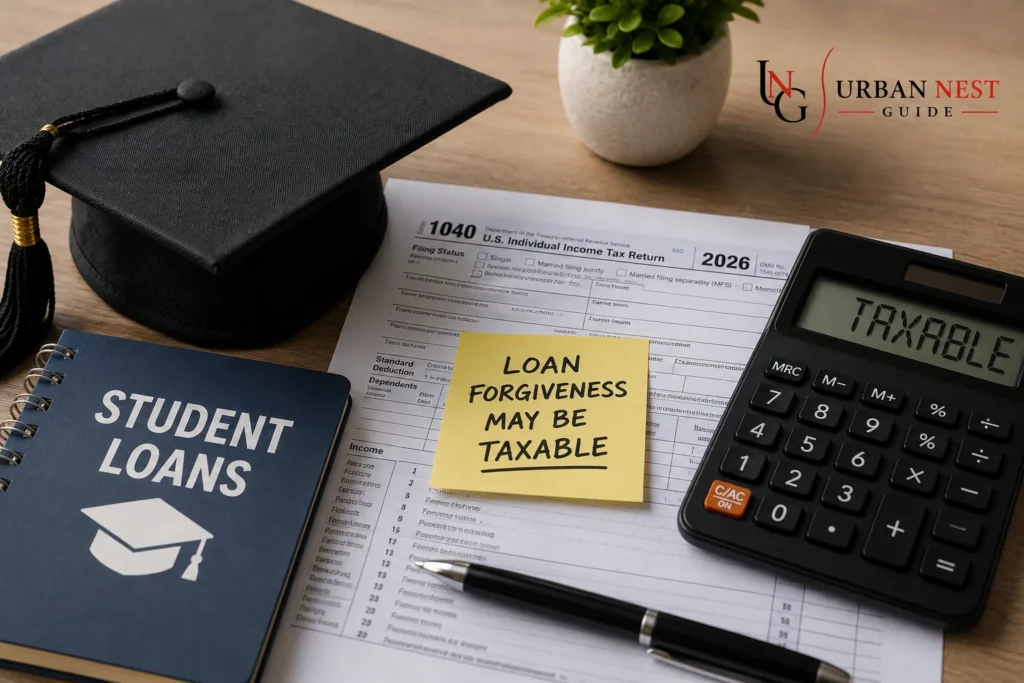
If you’ve been counting down the years until your loan balance disappears, there’s a detail that changed quietly and could catch a lot of borrowers off guard: the forgiven amount might now come with a tax bill attached.
Quick Answer
Yes, for most borrowers. The federal provision that made student loan forgiveness tax free expired at the end of 2025. Forgiveness processed in 2026 through income-driven repayment plans is generally taxed as ordinary income, though Public Service Loan Forgiveness remains tax-free by separate, permanent law.
What Actually Changed
Back in 2021, the American Rescue Plan included a provision making student loan forgiveness federally tax-free through the end of 2025.
That provision was temporary by design, and it was not extended.
For forgiveness processed in 2026 or later, the general rule under the tax code applies again: canceled debt counts as income.
Which Forgiveness Is Affected, and Which Isn’t
- Public Service Loan Forgiveness (PSLF) stays tax free under a separate, permanent section of the tax code; this expiration does not touch PSLF.
- Income-driven repayment forgiveness (after 20 or 25 years on a plan like IBR) is generally taxable again starting with amounts forgiven in 2026.
- Borrower defense and closed-school discharges can have different treatment depending on the circumstances; check current IRS guidance for your specific situation.
- Disability discharges may still qualify for an exclusion under a different provision, separate from the ARP rule that expired.
What the Bill Could Actually Look Like
Say a borrower has $45,000 forgiven through an income-driven repayment plan in 2026 and falls in the 22% federal tax bracket.
That forgiven amount gets added to their taxable income for the year, which, depending on their other income, could mean somewhere in the neighborhood of $9,000 to $10,000 in additional federal tax owed, all due at once rather than spread out.
That’s the part people mean when they call this a “tax bomb”: it’s not extra monthly payments; it’s one large bill showing up at tax time.
Read Also: How to Build an Emergency Fund →
Does Your State Tax It Too?
This is where it gets more complicated, because federal rules and state rules don’t automatically match.
Some states follow the federal treatment closely and won’t add their own tax on top; others have their own rules and may tax forgiven student debt as income regardless of what the federal government does.
There isn’t one universal answer here, so checking your own state’s department of revenue, or a qualified tax professional, before assuming either way is worth the extra step.
What to Actually Do About It
- If you know forgiveness is coming in 2026, start setting money aside now rather than being surprised in April.
- Consider adjusting your tax withholding at your job, or making a quarterly estimated payment, to avoid an underpayment penalty on top of the tax itself.
- Keep any official forgiveness notice and loan servicer paperwork; you’ll want the exact forgiven amount and date for your tax filing.
- If the amount is large, a short consultation with a tax professional before the forgiveness is finalized can be worth far more than it costs.
FAQs
Q1. Do I have to pay taxes on forgiven student loans in 2026?
In most cases involving income-driven repayment forgiveness, yes. The temporary tax-free treatment from the American Rescue Plan expired at the end of 2025 and was not renewed.
Q2. Is PSLF still tax free in 2026?
Yes. Public Service Loan Forgiveness is tax-free under its own permanent provision in the tax code, separate from the ARP rule that expired, so this change does not affect PSLF borrowers.
Q3. Will I get a 1099-c for forgiven student loans?
Often, yes. Lenders and loan servicers generally issue a Form 1099-C when a debt of $600 or more is canceled, which you’ll need when filing your taxes for that year.
Q5. Can I avoid the tax bomb on student loan forgiveness?
There’s no way to avoid it entirely if your forgiveness is taxable, but you can manage it: setting money aside in advance, adjusting withholding, and making estimated payments can prevent it from becoming an unmanageable surprise.
Key Takeaways
- The tax free treatment of student loan forgiveness expired at the end of 2025 and was not extended.
- PSLF remains permanently tax-free; income driven repayment forgiveness generally does not.
- A large forgiven balance can mean thousands of dollars in tax owed in a single year.
- State tax treatment varies; don’t assume your state follows the same rule as the federal government.
Sources Cited: IRS Taxpayer Advocate Service, what to know about student loan forgiveness and your taxes taxpayeradvocate.irs.gov. Federal Student Aid, official loan forgiveness program information studentaid.gov
Disclaimer: This article is for general education, not financial or legal advice.
About The Author