 Akash Kumar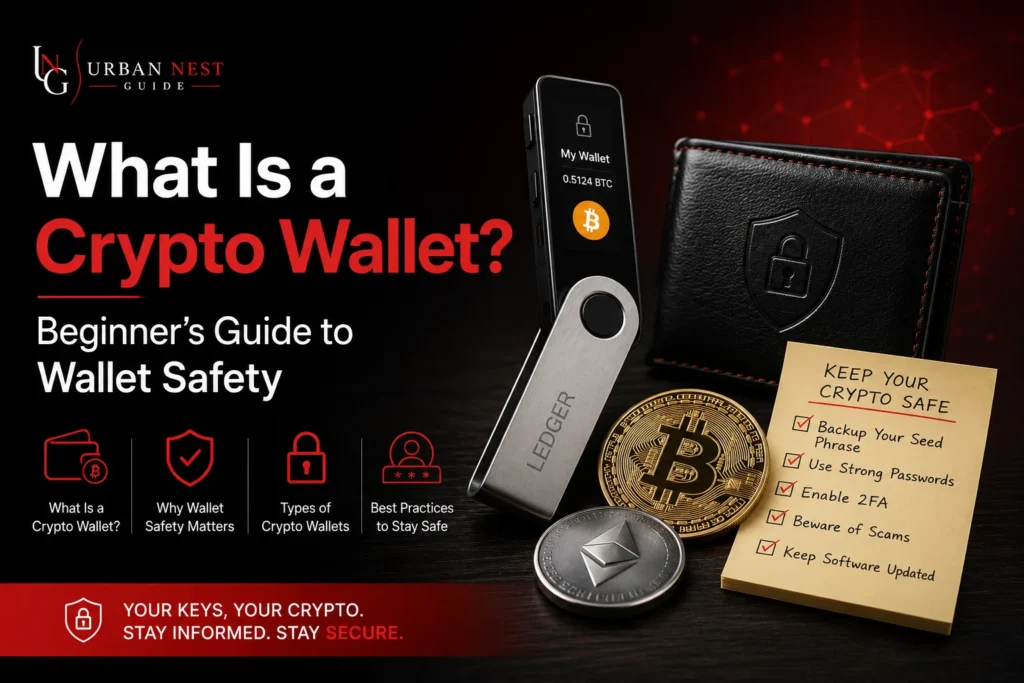
This is the single most misunderstood part of crypto for beginners, and it’s the reason “I lost my coins” stories keep happening. Let’s clear it up properly.
Quick Answer
A crypto wallet doesn’t actually store your coins; your coins live on the blockchain. What a wallet stores is the private key that proves those coins are yours and lets you move them. Lose the private key (or the seed phrase that recreates it), and you lose access to the coins, permanently, with no customer service line to call.
How a Crypto Wallet Actually Works
Every crypto wallet is built around a key pair: a public key (which works like an account number, safe to share; it’s what people send you coins to) and a private key (which works like a password; never share this, ever). Most wallets represent your private key as a seed phrase: a list of 12 or 24 plain English words. That phrase is the master backup for your entire wallet; anyone who has it can recreate your wallet and move your coins, and if you lose it with no other backup, no one, including the wallet company, can recover it for you.
Hot Wallets vs. Cold Wallets
A hot wallet is connected to the internet, a mobile app or a browser extension, for example. It’s convenient for everyday use but more exposed to hacking, malware, and phishing since it’s always online. A cold wallet is a
physical device (a hardware wallet) that keeps your private key completely offline. It’s less convenient; you need the physical device to approve transactions but dramatically more secure, since remote hackers simply can’t reach a key that was never connected to the internet in the first place.
Custodial vs. Non-Custodial: Who Actually Holds the Keys
A custodial wallet is one where an exchange (like Coinbase or Kraken) holds your private keys on your behalf similar to how a bank holds your money. It’s beginner-friendly and has account recovery options if you forget a password. A non-custodial wallet (like MetaMask, or a hardware device like a Ledger or Trezor) means you and only you hold the keys. There’s a well-known phrase in crypto for this exact tradeoff: “not your keys, not your coins.” Custodial is easier; non-custodial is more in your control, but with zero safety net if you lose access.
Comparing Your Options
| Wallet type | Convenience | Security | Best for |
| Hot (app/browser) | High | Lower, always online | Everyday small transactions |
| Cold (hardware) | Lower, need the device | Highest, offline storage | Long-term holdings, larger amounts |
| Custodial (exchange) | Highest, password reset available | Depends on the exchange’s security | Beginners just getting started |
| Non-custodial | Medium | High, but 100% your responsibility | Anyone who wants full self-control |
Cryptocurrency for Beginners: How to Start Investing Safely
Discover the fundamentals of cryptocurrency, learn how to buy your first digital assets, understand wallets and exchanges, and follow essential security practices to protect your investments.
Setting Up Your First Wallet, Safely
- Start with a reputable, well-known app if you’re custodial, or a well-known non-custodial option if you’re ready for self-custody.
- Write your seed phrase down on paper (never a screenshot, never a note app, never cloud storage) and store it somewhere private and fireproof if possible.
- Turn on two-factor authentication (2FA) using an authenticator app, not just SMS, wherever it’s
- Send a small test transaction first before moving a large amount to confirm the address and process work as
Mistakes and Scams That Cost Beginners Real Money
- Typing a seed phrase into any website or app that asks for it “to verify your wallet”; legitimate wallets never ask for this after setup.
- Storing a seed phrase as a photo on a phone that’s later lost, stolen, or
- Clicking links from unsolicited DMs or emails claiming a wallet needs urgent “verification.”
- Sending a test transaction to the wrong address because it wasn’t copy-pasted carefully, blockchain transactions can’t be reversed.
Key Takeaways
- A crypto wallet stores your private keys, not your coins. Your coins always remain on the blockchain.
- Hot wallets are convenient because they’re connected to the internet, while cold wallets are less convenient but offline and safer.
- Custodial wallets mean someone else holds your keys. Non-custodial wallets mean you control your own keys with no safety net if they’re lost.
- Never, ever type your seed phrase into a website, app, or message asking you to “verify” it.
FAQs
Q1. Is a hot wallet safe enough for beginners?
For small amounts you’re actively using, yes, hot wallets from reputable providers are reasonably safe when paired with 2FA and careful habits. For larger, long-term holdings, moving to a cold wallet is the more cautious choice.
Q2. What happens if I lose my seed phrase?
If you lose the seed phrase and also lose access to the wallet itself (a broken phone, a reset device), the funds are generally unrecoverable. This is why writing it down in a safe physical location, separate from the device itself, matters so much.
Q3. Do I really need a hardware wallet as a beginner?
Not on day one. Many beginners start custodial or hot-wallet while learning the basics, then move meaningful amounts to a hardware wallet once they’re holding more than they’d be comfortable losing.
Q4. Can crypto wallets be hacked?
Hot wallets and custodial exchange accounts can be compromised through phishing, malware, or exchange breaches. A properly secured cold wallet, kept offline and never exposing its seed phrase, is far harder to reach remotely.
Educational content and not financial advice. Figures are 2026 estimates; verify before relying on them.
About The Author