
 Akash Kumar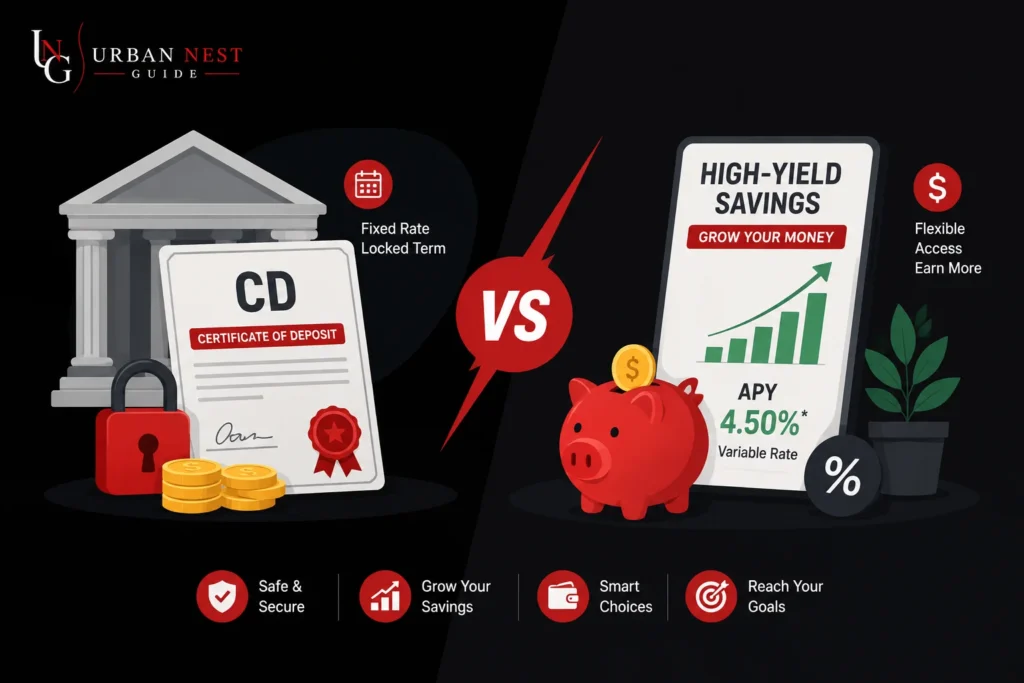
Right now, in 2026, CDs and high-yield savings accounts are paying almost the exact same rate.
Which means the usual advice, “CDs pay more”, doesn’t really hold up at the moment.
So which one should actually get your money? It depends on one thing: how soon you might need it.
Here’s the real comparison, with actual 2026 numbers, not generic advice that ignores what rates are doing right now.
Quick Answer
As of August 2026, the best CDs and best high-yield savings accounts are both paying somewhere between 3.00% and 5.00% APY, essentially a tie.
A CD locks in that rate for a set term. A HYSA’s rate can move at any time, but your money stays fully accessible.
When rates are this close, accessibility usually wins, unless you’re confident rates are about to drop.
Let’s break down exactly when each one makes sense.
Why These Rates Are So Close Right Now
This wasn’t always the case. A few years ago, CDs reliably paid more than savings accounts, a clear reward for locking up your money.
That gap has mostly closed. Here’s why:
The Federal Reserve has been cutting its benchmark rate since late 2024, and CD rates, which often price in future rate expectations, have drifted down faster than HYSA rates in some cases.
At the same time, online banks compete aggressively for savings deposits, keeping HYSA rates surprisingly resilient.
The result: two products that used to have a clear winner now often don’t.
How Each One Actually Works
High-Yield Savings Account
A savings account, usually at an online bank, paying a variable rate well above the national average. Deposit and withdraw whenever you want, within typical monthly transfer limits.
Read Also: High-Yield Savings Accounts Explained →
Certificate of Deposit
You lock in a fixed rate for a set term, commonly 6 months to 5 years. In exchange for giving up access, the rate is fixed for the entire term, even if market rates drop after you open it.
Same basic goal, safe growth on cash. Very different tradeoffs.
The Real Numbers Right Now
| Account Type | Typical Best Rate (Aug 2026) | National Average |
| High-yield savings | ~4.00% APY | ~0.38% APY |
| 6-month CD | ~4.00–4.25% APY | ~1.38% APY |
| 1-year CD | ~4.00–4.75% APY | ~1.65% APY |
| Traditional savings | N/A | ~0.10–0.20% APY |
Notice the gap between “best rate” and “national average” in every row. Most people are earning the average, not the best, simply by staying at their existing bank.
| Real Example: $10,000, Both Ways
Put $10,000 in a HYSA paying 4.00% APY. After one year: roughly $400 in interest, and the money was accessible the entire time. Put the same $10,000 in a 1-year CD paying 4.75% APY. After one year: roughly $475 in interest, but the money was locked up the whole time. Difference: about $75 for the year. That’s the actual price of accessibility right now, not the dramatic gap people assume exists. |
When a CD Actually Wins
Pick a CD when:
- You’re confident rates are heading lower and want to lock in today’s rate before it drops.
- You have a specific expense timeline, like a wedding in 14 months, and want a guaranteed amount by then.
- You won’t need the money before the term ends, genuinely, not “probably.”
A CD is a bet that today’s rate beats tomorrow’s rate. In a falling-rate environment, that bet often pays off.
When a HYSA Actually Wins
Pick a HYSA when:
- This is your emergency fund. Full stop. Emergencies don’t wait for a CD to mature.
- You’re not sure when you’ll need the money.
- You think rates might actually rise, or at least aren’t confident they’re falling.
- You want the flexibility to move the money into something else the moment a better opportunity shows up.
For a real emergency fund, this isn’t a close call.
Our guide to building an emergency fund goes into exactly why liquidity matters more than a slightly higher rate for this specific pot of money.
The CD Trap Nobody Warns You About
Break a CD before maturity, and you’ll pay an early withdrawal penalty.
This can be a lot more painful than people expect:
- Short-term CDs (under 12 months): often 90 days of interest.
- Longer-term CDs (12+ months): often 180 days of interest, sometimes more.
- Some banks charge a flat percentage of the withdrawn amount plus a flat fee on top.
On a 2-year CD broken after 3 months, the penalty can wipe out most or all of the interest earned so far, sometimes touching your original principal.
Only lock money in a CD you’re genuinely confident you won’t need early. “Probably won’t need it” isn’t confident enough.
Where Rates Are Actually Headed From Here
Neither product exists in a vacuum. Both track, loosely, the Federal Reserve’s benchmark rate.
As of mid-2026, the Fed’s target range sits at 3.50% to 3.75%, down from its 2023 peak.
If the Fed keeps cutting, HYSA rates will likely keep drifting down too, since banks adjust variable rates in response. A CD locked in today would look increasingly attractive in hindsight.
If the Fed holds steady or reverses, a HYSA holder benefits immediately from any rate increase, while a CD holder is stuck at their locked-in rate, even if it’s now below market.
Nobody can predict this with certainty, which is exactly why the “when will you need the money” question matters more than trying to out-guess the Fed.
What About Inflation?
A rate that sounds good on paper isn’t automatically a good deal once inflation is factored in.
Here’s the quick math:
If your HYSA or CD pays 4.00% APY and inflation runs around 3%, your real, inflation-adjusted return is roughly 1%. Still positive, but not the dramatic win the headline rate suggests.
This is true of both products equally, so it doesn’t change the comparison between them. It’s worth knowing mainly so a 4% rate doesn’t feel like more progress than it actually is in real terms.
For money you want to genuinely grow ahead of inflation over the long run, that’s a job for investing, not a savings account or CD, regardless of which one you pick.
The Middle Ground: CD Laddering
Don’t want to fully choose one or the other? A CD ladder splits the difference.
Here’s how it works:
Instead of putting $12,000 into one 12-month CD, split it into four CDs of $3,000 each, maturing at 3, 6, 9, and 12 months.
As each one matures, you get partial access to your money on a rolling basis, while still capturing CD-level rates on most of the balance.
It’s more setup than a single HYSA, but it solves the “all locked up or none of it” problem CDs normally create.
| Real Example: A Ladder in Action
Deshawn has $16,000 he won’t need immediately but wants some access to periodically. He builds a ladder: $4,000 each in 3-month, 6-month, 9-month, and 12-month CDs, all around 4.00-4.50% APY. Every 3 months, one CD matures. He can spend it, reinvest it in a new 12-month CD, or move it to his HYSA. He’s capturing CD-level rates on the full $16,000 while never waiting more than 3 months for a portion to become available. |
A Simple Way to Actually Decide
Ask yourself one question: could I need this money in the next 6 months, even in a worst-case scenario?
- If yes, it goes in a HYSA. No exceptions, regardless of how much better a CD rate looks on paper.
- If no, but within 1-2 years, a short-term CD or a CD ladder is worth comparing against a HYSA rate.
- If it’s genuinely long-term money you won’t touch for years, it probably belongs invested rather than in either a CD or a savings account, since neither is designed to outpace inflation by much over long periods.
This one question resolves most of the confusion faster than comparing rate sheets.
6 Mistakes People Make Choosing Between Them
Mistake #1: Putting an emergency fund into a CD
The whole point of an emergency fund is instant access. A CD actively works against that, no matter how good the rate looks.
Mistake #2: Not comparing your bank’s actual rate to the best available rate
Most people earn the national average, sitting at a fraction of what a top HYSA or CD pays, simply out of inertia.
Mistake #3: Locking into a long CD term without reading the penalty terms
A 5-year CD’s early withdrawal penalty can be brutal. Always read the specific penalty before committing to a long term.
Mistake #4: Assuming CDs always beat savings accounts
That was true for years. It’s not automatically true right now, in 2026’s specific rate environment.
Mistake #5: Forgetting HYSA rates can drop without warning
Unlike a CD, a HYSA’s rate is variable. It can move down at any time, including right after you deposit.
Mistake #6: Not checking FDIC or NCUA coverage
Both CDs and HYSAs are insured up to $250,000 per depositor, per institution, but only at insured banks and credit unions. Always confirm before depositing.
The Quick-Reference Table
| High-Yield Savings | Certificate of Deposit | |
| Rate type | Variable, can change anytime | Fixed for the full term |
| Access to funds | Anytime | Locked until maturity |
| Early withdrawal penalty | None | Yes, often 90–180 days of interest |
| Best for | Emergency funds, short-term goals | Money you won’t touch before a set date |
| FDIC insured | Yes, up to $250,000 | Yes, up to $250,000 |
FAQs
Is a CD or HYSA better for an emergency fund?
A HYSA, almost always. Emergency funds need instant access, and a CD’s early withdrawal penalty directly conflicts with that purpose.
Can I lose money in a CD or HYSA?
No, as long as the institution is FDIC or NCUA insured and your balance is under the $250,000 coverage limit. The only “loss” risk is the early withdrawal penalty on a CD.
Do CD rates ever beat HYSA rates by a lot?
Yes, historically, especially in periods when the Federal Reserve is expected to cut rates. As of 2026, the gap has mostly closed, but it does shift with the rate environment.
What happens when my CD matures?
You typically choose to withdraw the funds, roll them into a new CD, or in some cases the bank automatically renews it at the current rate unless you say otherwise. Check your specific bank’s policy.
Is a no-penalty CD worth it?
Sometimes. No-penalty CDs let you withdraw early without a fee but usually pay a slightly lower rate than a standard CD as a tradeoff for that flexibility.
How often do HYSA rates change?
There’s no fixed schedule. Rates can move whenever the bank decides, often (but not always) tracking Federal Reserve rate changes.
Should I keep all my savings in one CD or HYSA?
Not necessarily. Splitting funds by purpose, an emergency fund in a HYSA and separate near-term savings goals in CDs, usually makes more sense than one giant account.
Is now a good time to lock in a CD?
It depends on your view of where rates are headed. If the Fed continues cutting rates, locking in today’s CD rate looks better in hindsight; if rates rise instead, a HYSA adjusts upward automatically while a CD doesn’t.
Neither product is objectively better. They’re built for different jobs.
The real question was never “which pays more.” It’s “which matches when I’ll actually need this money.” Answer that first, and the rest is just picking the best rate in that category.
The Bottom Line
CDs and HYSAs are paying nearly identical rates in 2026, so the usual “CDs pay more” advice doesn’t hold up right now.
Choose a HYSA for anything you might need access to, especially an emergency fund.
Choose a CD only for money you’re genuinely confident you won’t touch before the term ends.
A CD ladder is a reasonable middle ground if you want CD-level rates with some rolling access.
Sources Cited: FDIC, National Rates and Rate Caps. Federal Reserve, Federal Funds Rate data
Disclaimer: This article is for general education, not financial advice. Everyone’s situation is different; adapt these tips to your own budget and goals.
About The Author