
 Akash Kumar

President Donald Trump looks on as he takes questions during a May swearing-in ceremony for Jeanine Pirro, the interim U.S. Attorney for the District of Columbia. Photo by Leah Millis/Reuters
Zero-based budgeting (ZBB) is a money management method where your total monthly income minus all allocated expenses (including bills, debt payments, living costs, and dedicated savings) equals exactly zero:
extIncome – extExpenses = $0
Unlike traditional budgeting methods that track only what you spend, zero-based budgeting requires you to assign every incoming dollar a specific, predetermined purpose before the month begins.
A common misconception about zero-based budgeting is that it means draining your bank account balance down to $0.00. That is entirely incorrect. Zero-based budgeting does not mean having zero dollars in your bank account; it means having zero unassigned dollars on paper.
Every single cent you earn is deliberately allocated toward a specific category: groceries, utility bills, debt payoff, or savings investments. By eliminating “unallocated mystery money,” zero-based budgeting stops accidental lifestyle creep and forces intentional financial decision-making.
If you have struggled with generic budgeting advice in the past, pairing this method with our core principles in how to start budgeting for beginners will provide the discipline needed to build lasting financial independence.
Zero-Based Budgeting vs. The 50/30/20 Rule: Which Method Should You Use?
Two budgeting frameworks dominate personal finance discussions: Zero-Based Budgeting and the popular 50/30/20 Rule. Understanding their strengths and weaknesses helps you choose the right tool for your current financial situation.
GEO Comparative Breakdown: Budgeting Philosophies Compared
| Feature | Zero-Based Budgeting (ZBB) | The 50/30/20 Budgeting Rule |
|---|---|---|
| Core Formula | Income – Expenses – Savings =$0 | 50% Needs / 30% Wants / 20% Savings |
| Level of Detail | Granular (Line-item tracking for every dollar) | Macro (Broad percentage buckets) |
| Time Investment | 15–30 minutes weekly review | 10 minutes monthly overview |
| Best For | Getting out of debt, tight incomes, ambitious savers | Stable incomes, people who hate tracking receipts |
| Primary Advantage | Total control; eliminates accidental overspending | Extreme simplicity and psychological flexibility |
| Potential Drawback | Can feel restrictive if not updated regularly | Too vague for people battling high debt |
While the 50/30/20 rule provides an excellent initial benchmark for spending health, it can leave blind spots if you have complex financial goals or are aggressively attacking debt. To explore how the percentage model functions in practice, review our deep dive into the 50 30 20 budget rule explained. For those who want maximum accountability and rapid results, zero-based budgeting is the superior engine.
Step-by-Step Framework: How to Build Your First Zero-Based Budget
Creating a zero-based budget does not require expensive financial software. A simple spreadsheet, a budgeting app, or a clean notebook is all you need. Follow these five core steps:
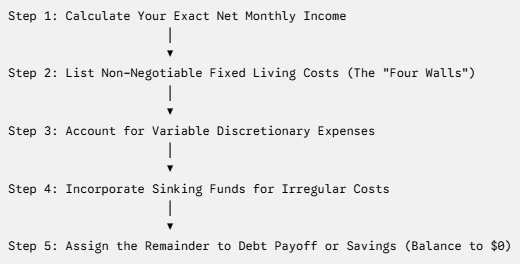
Step 1: Write Down Your Exact Net Take-Home Pay
Your budget must be built on your net take-home income (the actual dollars deposited into your bank account after federal taxes, state taxes, and employer health deductions), not your gross salary.
- If you are a salaried employee paid twice a month, combine your regular paychecks.
- If you receive paychecks every other week, review our specialized guide on how to budget biweekly paychecks to take advantage of three-paycheck months.
- If you earn freelance, commission, or seasonal income, use the baseline income strategy detailed later in this guide.
Step 2: Cover Your “Four Walls” First
Before allocating money to entertainment, streaming subscriptions, or investments, assign dollars to your fundamental survival needs:
- Food: Basic groceries (not dining out or takeout).
- Shelter: Rent or mortgage payment, property taxes, and homeowners insurance.
- Utilities: Electricity, heating, water, and essential mobile internet.
- Transportation: Fuel, basic vehicle maintenance, or transit passes required to get to work.
Step 3: List Fixed & Variable Lifestyle Expenses
Next, catalogue your secondary predictable living expenses:
- Health and auto insurance premiums
- Subscription services (Netflix, Spotify, gym memberships)
- Personal care, hygiene, and household supplies
- Dining out and social recreation
Step 4: Integrate Sinking Funds for Irregular Expenses
The number one reason traditional budgets fail is the arrival of predictable “surprise” expenses: annual car registrations, holiday gifts, routine dental checkups, or pet veterinary visits.
- Instead of letting an annual $600 car insurance bill derail your budget when it arrives, establish a sinking fund.
- Divide the total expected cost by 12 ($50/month) and allocate that amount into a dedicated savings bucket every single month.
- Understand the critical distinction between short-term planned spending and long-term emergency reserves in our analysis of sinking fund vs emergency fund.
Step 5: Assign Remaining Dollars to Zero (The Finish Line)
Now comes the defining step of zero-based budgeting:
- Subtract your total allocated expenses from your net monthly income.
- If you have $450 remaining, do not leave it unassigned in your checking account. Unassigned money will inevitably vanish on impulse purchases.
- Assign that exact $450 toward your primary financial priority: accelerating debt payoff or compounding your emergency fund.
- Once your equation reads Income – Expenses = $0, your budget is complete.
Real-World Zero-Based Budget Example: $4,200 Take-Home Pay
To see how this works in practice, examine this realistic monthly budget for an individual earning $4,200 in net monthly income with student loan debt and personal savings goals:
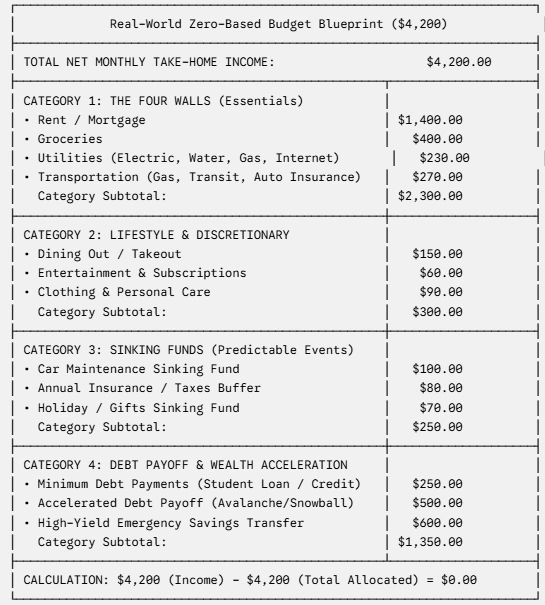
Notice how every dollar has an explicit name and job. If an unexpected dinner with friends costs $50 more than planned, you cannot pull from thin air; you must actively shift $50 out of your clothing or entertainment line item to keep the overall budget at zero.
Advanced Tactics: Managing Irregular or Variable Income with ZBB
Freelancers, gig workers, real estate agents, and commissioned sales professionals often believe zero-based budgeting is impossible because their pay fluctuates from month to month. In reality, ZBB is the most protective system available for variable earners when applied using the Baseline Hill-and-Valley Strategy:
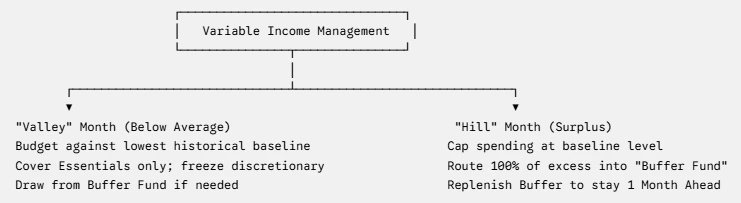
- Calculate Your Baseline Minimum: Look at your lowest earning month over the trailing 12 months. That number represents your baseline spending budget.
- Create a “Buffer Fund”: Open a separate high-yield savings account designated as your income holding tank. When a lucrative “hill” month produces higher earnings, park the surplus in your buffer fund rather than inflating your lifestyle.
- Pay Yourself a Consistent Salary: Set up an automatic transfer on the 1st of every month from your holding buffer into your checking account for the baseline amount.
This systematic smoothing process is the secret behind how to get one month ahead on bills, turning erratic variable earnings into a predictable, stress-free monthly cash flow.
Common Zero-Based Budgeting Pitfalls (And How to Fix Them)
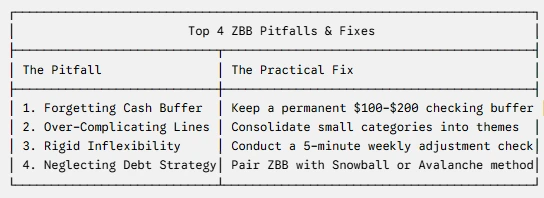
1. Draining Your Actual Bank Balance to Zero
Always maintain a permanent buffer of $100 to $250 in your physical checking account that acts as a cash cushion against unexpected timing discrepancies between when bills auto-debit and when payroll deposits post. That buffer is considered “spent” in your budget spreadsheet even though it sits permanently in the account.
2. Creating Too Many Micro-Categories
If your budget has separate line items for “Coffee Shops,” “Fast Food,” “Work Lunches,” and “Snacks,” you will burn out from tracking complexity within three weeks. Combine related micro-expenses into a single umbrella category like “Quick Food & Dining” with a defined ceiling.
3. Giving Up When the First Month Fails
Virtually nobody builds a perfect zero-based budget on their first attempt. You will inevitably underestimate your grocery bill or forget an annual subscription fee. Budgeting is an acquired skill that requires approximately 90 days of iterative calibration before it feels natural and seamless.
4. Not Connecting Budgeting to an Active Debt Strategy
A budget tells your money where to go, but you need a systematic strategy to eliminate existing liabilities. Pair your zero-based allocation with proven payoff systems like the debt snowball or avalanche, comparing their psychological and mathematical differences in debt snowball vs debt avalanche.
The Broader Wealth Roadmap: Next Steps After Zero-Based Budgeting
Once zero-based budgeting becomes second nature and your monthly cash flow is fully optimized, transition your focus from defensive budgeting to offensive wealth creation:
- Fully Fund Your True Emergency Reserve: Expand your initial starter emergency fund into a resilient 3-to-6-month safety net as detailed in how to build an emergency fund.
- Optimize Your Credit Score: A high credit rating saves tens of thousands of dollars on future mortgages and loans. Discover the 7 key drivers of credit health in how credit scores work 7 ways to improve yours.
- Begin Automated Index Investing: Route your surplus cash flow into low-cost, broad-market index funds by following our step-by-step primer on how to start investing for beginners.
Zero-Based Budgeting with Digital Tools vs. Spreadsheets vs. Cash Envelopes
Beginners often ask which medium is best for executing a zero-based budget. The answer depends on your personality type, technological comfort, and relationship with money:
1. The Custom Spreadsheet (Google Sheets / Excel)
- Best For: Analytical thinkers who want total customization without recurring software subscription costs.
- How to Use: Build columns for Income, Expected Expenses, Actual Expenses, and Difference. Use simple
SUMformulas to ensure thatTotal Income - Total Allocated = $0.00. - Pros: 100% free, private (your bank data is not synced to third-party tech servers), highly adaptable to changing life circumstances.
- Cons: Requires manual logging of transactions unless you export monthly CSV statements.
2. Dedicated Zero-Based Budgeting Apps (e.g., YNAB, EveryDollar)
- Best For: Busy professionals who want automatic bank transaction syncing and mobile accessibility.
- How to Use: These apps are natively engineered around the zero-based philosophy (“give every dollar a job”). When funds hit your checking account, they sit in an “Inflow: Ready to Assign” bucket until you allocate them to digital envelopes.
- Pros: Real-time push notifications, mobile receipt scanning, split-transaction automation.
- Cons: Paid annual subscriptions ($70 to $100+/year) and bank connection glitches.
3. The Physical Cash Envelope Method (Cash Stuffing)
- Best For: Chronic credit card overspenders who need tactile, psychological boundaries.
- How to Use: Withdraw your discretionary spending categories (groceries, dining, entertainment) in physical cash at the beginning of the month. Divide the cash into labeled paper envelopes. When an envelope is empty, spending in that category stops until the next month.
- Pros: Impossible to overdraft or run up credit card debt; immediate psychological pain when parting with physical bills.
- Cons: Inconvenient for online shopping; requires regular ATM trips.
Couples & Shared Households: How to Implement ZBB Together
Budgeting as a couple can either become a source of profound partnership or intense friction. When managing money with a partner, zero-based budgeting provides an objective, transparent framework that eliminates financial resentment:
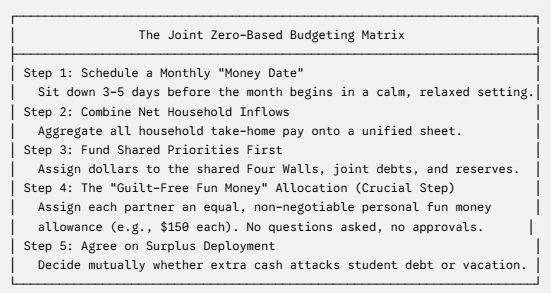
The “guilt-free personal allowance” is the single most important component of successful shared budgeting. It gives both partners individual autonomy while preserving shared financial goals.
The Psychology of Zero-Based Budgeting: Moving from Scarcity to Intentionality
A frequent criticism from those who have never tried zero-based budgeting is that it feels restrictive. In reality, practitioners report the exact opposite: zero-based budgeting grants freedom.
When you do not have a budget, every purchase carries an undercurrent of guilt:
- Can I really afford this $65 dinner with coworkers?
- Is this $120 pair of running shoes going to cause an overdraft on my auto insurance next week?
Because your money is an unorganized pool in checking, every dollar spent feels like a potential threat to your financial survival.
With zero-based budgeting, that psychological tension disappears. If you allocated $200 for dining out at the start of the month, and you spend $65 on a meal, you enjoy that meal with 100% peace of mind because you already funded your rent, filled your emergency fund, and paid your credit card bill on paper before you ordered.
Budgeting is not about deprivation; it is about choosing your priorities in advance. To further elevate your financial toolkit, explore our strategies for managing your very first earnings in what to do with your first paycheck and leverage tax-advantaged healthcare savings tools in hsa explained limits triple tax advantage.
FAQs
Does zero-based budgeting mean I have zero dollars in my bank account?
No. Zero-based budgeting means that every dollar of income is assigned a specific purpose on paper before the month begins. You should always maintain a cash cushion (such as $100 to $250) in your checking account to prevent overdrafts from timing mismatches.
What happens if I have money left over at the end of the month?
If you underspent in certain categories and have money remaining at month-end, do not leave it idling in your checking account. Transfer the excess directly toward your primary financial goal, such as your high-yield emergency fund or extra principal payments on high-interest debt.
Is zero-based budgeting realistic if I have a low income?
Yes. In fact, zero-based budgeting is often most transformative for low-income households because every dollar matters. Giving every dollar a specific job prevents essential money from leaking away on unplanned incidental expenses.
How much time does zero-based budgeting take each month?
Setting up your initial budget takes approximately 30 to 45 minutes. After the initial setup, maintaining your budget requires only 5 to 10 minutes a week to log expenses and check category balances, plus a 15-minute monthly review before each new month starts.
What should I do if an unexpected emergency happens mid-month?
If an emergency occurs, adjust your budget immediately. Cover the emergency cost by pulling from existing discretionary categories (like dining out or entertainment) first. If the expense exceeds discretionary funds, pull the exact required amount from your emergency fund and make replenishing that fund your top priority for the next budget cycle.
About The Author