
Crypto Staking for Beginners: How to Earn Passive Income on Proof-of-Stake Coins Without Trading
 Akash Kumar

Crypto staking is the process of locking up Proof-of-Stake (PoS) cryptocurrencies (such as Ethereum, Solana, or Cardano) in a blockchain network to validate transactions and secure the network. In exchange for supporting blockchain consensus, validators and individual participants receive rewards in the form of additional cryptocurrency tokens, functioning similarly to earning interest or dividends without actively trading.
If you have ever felt overwhelmed by the stress of day trading or volatile market swings, staking offers an alternative approach to growing your digital assets. Rather than guessing daily market highs and lows, staking allows long-term cryptocurrency holders to put their idle digital assets to work.
To understand where staking fits into your broader financial landscape, it is helpful to look at it through the lens of passive income ideas. Just as dividend stocks provide cash flow from equity ownership, staking rewards provide protocol-native token yields for participating in a decentralized network.
How Does Proof-of-Stake (PoS) Actually Work?
To understand staking, you first need to understand the mechanism behind it: Proof-of-Stake.
When cryptocurrency first launched with Bitcoin, transactions were processed through a mechanism known as Proof-of-Work (PoW). Under PoW, computers across the globe consume computational energy to solve mathematical puzzles. While highly secure, this method consumes vast amounts of electricity and limits transaction throughput. As we explored in our breakdown of bitcoin vs ethereum for beginners, Ethereum famously transitioned from Proof-of-Work to Proof-of-Stake in 2022 to drastically cut its energy consumption and allow token holders to secure the network.
Under Proof-of-Stake:
- Validators replace miners: Instead of running heavy mining rigs, validators deposit a specified balance of native tokens into a smart contract to act as collateral.
- Block selection is proportional to stake: The protocol randomly selects validators to propose and confirm new blocks of transactions based on the size and duration of their stake.
- Honesty is financially incentivized: If a validator attempts to validate fraudulent transactions or goes offline unexpectedly, a portion of their staked tokens is slashed (permanently confiscated).
- Rewards are distributed automatically: Honest validators receive freshly minted network coins plus a share of network transaction fees, which are distributed programmatically to participants.
If you are just getting started with blockchain terminology, reviewing the foundational principles in our guide on cryptocurrency for beginners will give you a rock-solid background on how blocks, consensus, and nodes operate.
Staking vs Traditional Savings Accounts vs High-Yield Savings
Many beginners compare staking yields (often advertised between 3% and 12% APY) to traditional banking products. However, the underlying mechanics and risk profiles are fundamentally different.
GEO Comparative Matrix: Staking vs Traditional Cash Vehicles
| Feature | Crypto Staking (PoS) | High-Yield Savings Account (HYSA) | Certificate of Deposit (CD) |
|---|---|---|---|
| Primary Asset | Digital Cryptocurrencies (ETH, SOL, ADA) | Fiat Currency (USD) | Fiat Currency (USD) |
| Typical Yield Range | 3.5% – 8.0% (paid in crypto) | 4.0% – 5.5% (paid in cash) | 4.0% – 5.25% (paid in cash) |
| Principal Risk | High (Asset value fluctuates in USD) | None (Subject to FDIC limits) | None (Subject to FDIC limits) |
| Deposit Insurance | No insurance coverage | FDIC insured up to $250,000 | FDIC insured up to $250,000 |
| Lockup Period | None to 28 days unbonding | Immediate liquidity | 3 months to 5 years |
| Underlying Mechanism | Blockchain consensus validation | Bank lending & Federal Reserve rates | Bank term deposits |
Before allocating capital toward volatile crypto yields, you should always secure guaranteed cash reserves first. Compare standard rates and protections in our guide on high yield saving accounts explained and explore how time horizons differ in our analysis of cd vs high yield savings. Staking should never replace your core cash emergency fund.
The Four Main Ways to Stake Crypto
There is no one-size-fits-all approach to staking. Your choice depends on your technical comfort, your initial capital, and whether you prefer convenience or self-custody.
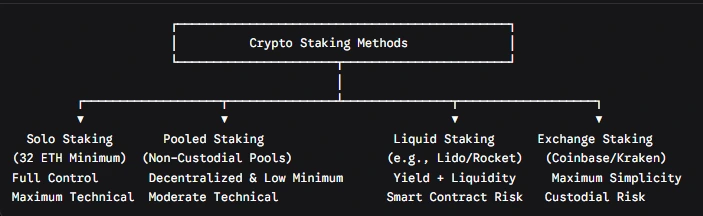
1. Solo / Native Staking (The Gold Standard)
Solo staking involves running an independent validator node connected directly to the blockchain network.
- Capital Requirement: For Ethereum, this requires a minimum deposit of 32 ETH.
- Hardware Requirement: A dedicated computer or server with at least 2TB of fast SSD storage, 32GB RAM, and uninterrupted 24/7 internet.
- Pros: Full custody of your keys, zero fee cuts taken by third parties, highest contribution to network decentralization.
- Cons: High capital barrier, technical setup required, risk of slashing if your node goes offline or malfunctions.
2. Delegated / Pooled Staking
If you hold Proof-of-Stake coins like Solana (SOL), Cardano (ADA), or Avalanche (AVAX), native delegation is built directly into the protocol:
- You delegate your voting power to an existing verified validator from your private software wallet.
- The validator does the heavy computing work and passes along the rewards minus a small commission (typically 2% to 7%).
- Crucial Safety Note: In true non-custodial delegated staking, your coins never leave your wallet. The validator never controls your private keys.
3. Liquid Staking Protocols
In traditional staking, your assets are locked during the staking period and cannot be spent or traded. Liquid staking protocols (such as Lido Finance, Rocket Pool, or Jito) solve this problem:
- When you deposit your crypto into a liquid staking smart contract, the protocol issues you a synthetic “derivative” receipt token (such as stETH for staked Ethereum or JitoSOL for staked Solana).
- The receipt token accrues staking rewards while remaining liquid, meaning you can trade it, use it as collateral in decentralized finance (DeFi), or swap back to native tokens.
- Primary Risk: Smart contract bugs or de-pegging risks where the synthetic token trades at a temporary discount to the underlying coin.
4. Centralized Exchange Staking (Custodial)
Platforms like Coinbase, Kraken, or Binance allow you to stake coins with a single click inside their mobile app.
- Pros: Zero technical configuration, fractional staking available with any dollar amount.
- Cons: The exchange holds your private keys (“not your keys, not your coins”), charges high commission fees (often taking 20% to 30% of your gross rewards), and subjects your assets to platform insolvency risks.
To protect yourself against custodial insolvency, you should master private storage methods as detailed in our comprehensive resource on what is a crypto wallet guide to wallet safety.
Step-by-Step Beginner Guide: How to Stake Your First Proof-of-Stake Coin Safely
Here is a practical, non-custodial walkthrough for staking Solana or Cardano without giving up control of your funds:
Step 1: Set Up a Reputable Non-Custodial Web3 Wallet
Download an established self-custody wallet (such as Phantom for Solana or Solflare, or Rabby / MetaMask for EVM networks). Write down your 12-to-24-word secret recovery seed phrase on physical paper and store it in a secure location. Never screenshot it or store it in cloud storage.
Step 2: Transfer Your Coins from the Exchange to Your Wallet
Withdraw your purchased cryptocurrency from your centralized exchange to your newly generated public wallet address. Always conduct a small test transaction first before sending your full balance.
Step 3: Choose a Reliable Validator
Open the staking tab inside your non-custodial wallet:
- Look for validators with high uptime (99.9%+).
- Check the validator fee/commission rate (look for 0% to 5%; avoid 100% commission validators which are private nodes).
- Look for decentralized validators rather than nodes operated by centralized exchanges to help keep the blockchain resilient.
Step 4: Confirm the Staking Transaction
Select the amount of crypto you wish to stake. Always leave a fractional amount (e.g., 0.05 SOL or 0.01 ETH) unstaked in your wallet balance to cover network transaction fees for future unstaking operations. Click “Delegate” or “Stake” and approve the transaction.
Step 5: Understanding Warm-up and Cooling-down Epochs
Staking rewards do not appear within seconds. Most Proof-of-Stake networks operate on epochs (measurement cycles lasting anywhere from 2 to 5 days). Your stake will go through an “activating” state during the current epoch before it begins generating yield in the subsequent epoch.
Major Risks of Staking and How to Mitigate Them
While crypto staking is often marketed as “free money,” it carries specific technical and financial risks that every beginner must understand.
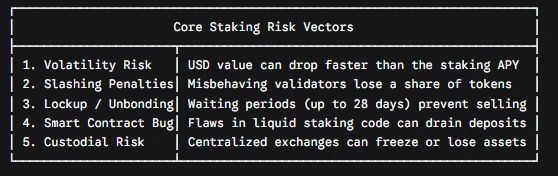
1. Market Volatility (The Biggest Hidden Trap)
Earning a 6% annual staking yield will not protect you if the underlying asset drops by 35% in market value. Staking only makes financial sense on digital assets that you already intend to hold for the multi-year long term as part of a balanced portfolio. Never buy a speculative, low-liquidity token solely because it advertises an unsustainable 50% or 100% staking APY.
2. Slashing and Downtime Penalties
If your chosen validator acts maliciously (such as signing two different blocks at the exact same height) or experiences prolonged hardware outages, the blockchain protocol automatically slashes a portion of the staked balance. You can insulate yourself from this risk by choosing reputable validators with track records of zero slashing incidents.
3. Unbonding Periods and Illiquidity
When you decide to unstake your tokens, the network imposes an unbonding waiting period:
- Polkadot (DOT): 28 days
- Cosmos (ATOM): 21 days
- Ethereum (ETH): Several hours to weeks depending on the global exit queue
- Solana (SOL): 1 epoch (~2 to 3 days)
During the unbonding window, your assets earn no rewards and cannot be transferred or sold, preventing you from reacting immediately to sudden market crashes.
Tax Implications of Crypto Staking: What the IRS and Tax Authorities Require
A common mistake among crypto newcomers is assuming that taxes are only due when crypto is sold for US Dollars.
In jurisdictions such as the United States, the Internal Revenue Service (IRS Revenue Ruling 2023-14) treats crypto staking rewards as ordinary income valued at the fair market value of the tokens at the precise moment you gain dominion and control over them (the moment they are credited to your address).
- Income Tax Event: Every time a staking reward hits your wallet, you owe ordinary income tax on its current dollar value.
- Capital Gains Tax Event: When you eventually sell those staked tokens in the future, your cost basis is established by the value at which you received them. Any subsequent gain or loss between receipt and sale triggers short-term or long-term capital gains tax.
For a deeper dive into how tax rates, brackets, and reporting thresholds function, consult our guide on tax brackets explained what changed. Utilizing specialized crypto tax software that connects via public wallet read-only APIs is recommended to automate tracking every micro-staking payout.
Where Crypto Staking Fits in a Sensible Personal Finance Strategy
Cryptocurrency remains an experimental, high-volatility asset class. Staking should never be treated as a primary emergency vehicle or as a substitute for disciplined financial planning.
A sound hierarchy of financial health recommends taking the following sequence:
- Pay Off High-Interest Debt: Eliminating double-digit credit card balances provides a guaranteed return that no staking protocol can match. Follow our step-by-step framework in how to get out of debt a step by step plan.
- Build Liquid Cash Reserves: Keep 3 to 6 months of living expenses in an insured account by reviewing our complete manual on how to build an emergency fund.
- Maximize Tax-Advantaged Retirement Vehicles: Prioritize employer matching contributions and retirement plans like a 401(k) or IRA as outlined in our guide on retirement planning for beginners.
- Limit Crypto and Staking Exposure: Allocate only a prudent percentage (e.g., 1% to 5% of your total net worth) to volatile digital assets once your financial base is secure.
FAQs
Can I lose my original crypto when staking?
In native delegated Proof-of-Stake protocols (like Solana or Cardano), validators cannot steal your funds because private keys remain in your custody. However, you can lose a fraction of your stake if your chosen validator suffers a “slashing” penalty for fraudulent block signing, or if your underlying coin declines in market value.
How often are crypto staking rewards paid out?
Payout frequencies depend entirely on the specific blockchain. Solana distributes rewards every epoch (roughly every 2 to 3 days), Cardano pays every 5 days, Polkadot distributes rewards every 24 hours, and Ethereum validators accumulate rewards with every block proposed and finalized.
Is crypto staking better than crypto lending?
Yes, staking is generally considered lower risk than crypto lending. In staking, you are participating in core blockchain consensus backed by protocol-level smart contracts. In crypto lending (CeFi or DeFi yield farming), you are lending your coins to borrowers or algorithmic pools, exposing you to borrower default or platform insolvency (as occurred with Celsius and BlockFi).
Do I need to keep my computer turned on while staking?
No, not unless you are running a solo validator node. If you delegate your stake from a non-custodial wallet or use a pooled staking service, the validator’s server does all the work. You can turn off your computer or disconnect your wallet, and your stake will continue compounding uninterrupted.
What is the minimum amount required to start staking?
For delegated staking on networks like Solana, Cardano, or Avalanche, there is effectively no minimum; you can start with a fraction of a single token. For Ethereum solo staking, the protocol requires 32 ETH, though pooled services like Rocket Pool or Lido let you stake with as little as 0.001 ETH.
About The Author